



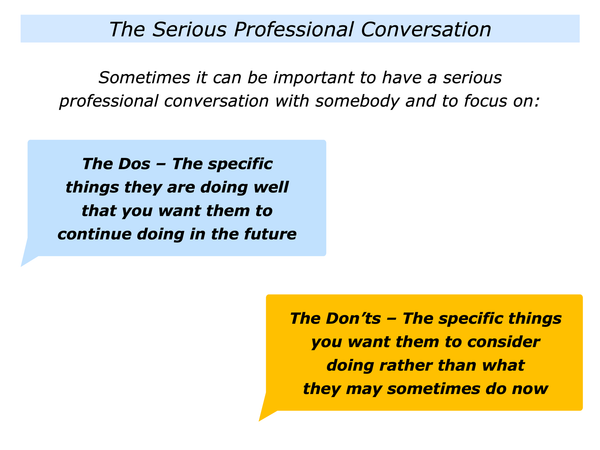
Imagine you are a leader. There may be times when it can be important to have a serious professional conversation with somebody. This could be when you want to help them to look to the future and to focus on:
The Dos – To continue building on what they are doing well and do more of these things in the future.
The Don’ts – To consider behaving in other ways in certain areas because their present behaviour may be causing issues.
Imagine that have already tried to give the person some messages about their professional approach. The situation may have reached a point, however, where it may be important to have a more serious conversation.
This may because the person: a) may be making a positive contribution in some areas: b) may be behaving in other ways that do not help themselves or other people.
You want to give the person a chance to build on what they do well but also improve in other areas. How to take this step? The following section looks at how one leader approached such a situation.
The Serious
Professional Conversation
The Chief Executive Officer of a company hired a senior project manager to help them to coordinate several key projects. The first couple of months went well and the various projects looked to be on track.
The project manager initially demonstrated a positive attitude and got things done. After a while, however, they fell into a pattern of continually wanting reassurance.
The person often began meetings by beating themselves up. They expressed doubts about their ability to deal with certain professional and personal challenges. This became a ritual before it was possible move on to focusing on the future.
The CEO was both a focused and empathetic person. They tried to balance driving the commercial aspects of the business forwards with also showing caring for their people.
Whilst they wanted to help the project manager, they started to find the one-to-one sessions exhausting. One of their senior colleagues brought the situation to a head by making the following observation.
“Who is supposed to be the helper here? The person was hired on a good salary to help you to deliver the projects.
“It is important to be empathetic, but it seems that you are spending lots of energy just helping them.”
The CEO decided to have a serious conversation with the project manager. They began the meeting by saying something along the following lines.
“I would like to have a conversation with you about your best contribution in the future. I am going to outline some ideas. Then I would like you to take some time to reflect and give your response.
“There are some areas where you are making a positive contribution and I would like you to build on these. There are others where I would like you to consider behaving in other ways to help us to achieve success.”
”As I said, I would like to share these ideas about us shaping a positive future. Then for you to get back to me with your response. Is that okay?”
At first the person expressed concern, but they then said it could be helpful to look towards the future. The CEO then aimed to maintain a positive tone. Looking ahead, they explained the following things.
The Dos
The specific things they did want the person to do – such as play to their strengths and deliver certain tangible results.
They also explained the positive benefits of doing these things – both for the person and for other people.
The Don’ts
The specific things they did not want the person to do – such as quickly move into talking about their self-doubts.
They explained what they would like the person to consider doing instead – plus the positive benefits for the person and other people.
The CEO explained that the project manager’s job was safe providing they behaved in a professional way. It was also okay to ask for help but in a way that explored how it was possible to improve in the future.
The person’s job may be at risk, however, if they continued to start meetings by being negative or looking for constant reassurance. It would be important to come with positive suggestions and practical ways forward.
The CEO said the company was happy to provide support on certain challenges. It employed an external therapist, for example, who could provide help with any deep issues.
Bearing this in mind, the CEO asked if the project manager had any practical questions before taking time to reflect. They reiterated the person could certainly make a positive contribution if:
They built on their strengths and delivered the agreed results;
They explored ways to develop in the other areas.
The project director responded a few days later. They realised it was important to be professional and have a positive attitude. They would also be open to talking with the therapist about certain issues at home.
The situation worked out in a relatively positive way. The project manager did behave professionally for the next six months and delivered the agreed goals.
The situation at home then became extremely challenging. Fortunately, they had some financial runway and they took some time off. They then later resumed their career.
Looking back, they realised that it was important to do a professional job rather than look for constant reassurance. They then focused on doing good work, whilst also learning to take care of themselves, in the future.
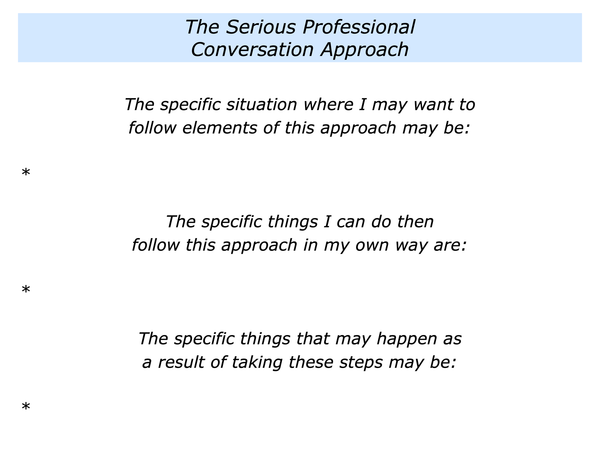
Let’s return to your own work. Looking ahead, can you think of a situation where you may want to follow elements of the serious professional conversation approach? How can you do this in your own way?
If you wish, try tackling the exercise on this theme. This invites you to complete the following sentences.

Leave a Reply