



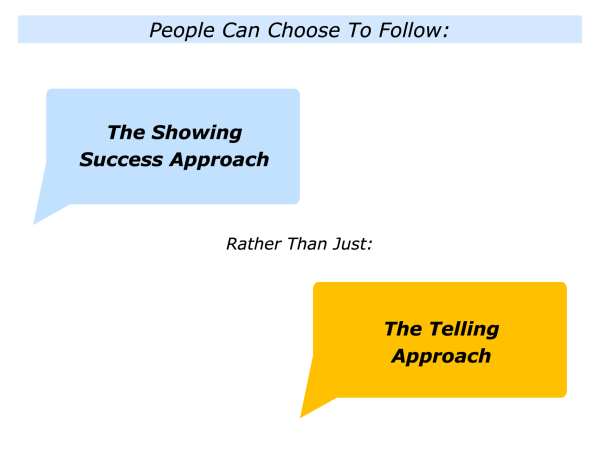
There are many ways to encourage people to focus on shaping a positive future. One approach involves following the old rule that it is important to show rather than just tell. This is because:
People buy success rather than the theory of success.
This approach follows the well-known writing rule that it is important to ‘show, don’t tell’ to bring ideas to life. People are more likely to believe what they see rather than just what they are told. There are many ways to follow this approach. These include:
The Showing What Good Looks Like Approach;
The Successful Prototypes Approach;
The Success Stories Approach.
The following pages provide more background about these approaches.
The Showing What
Good Looks Like Approach
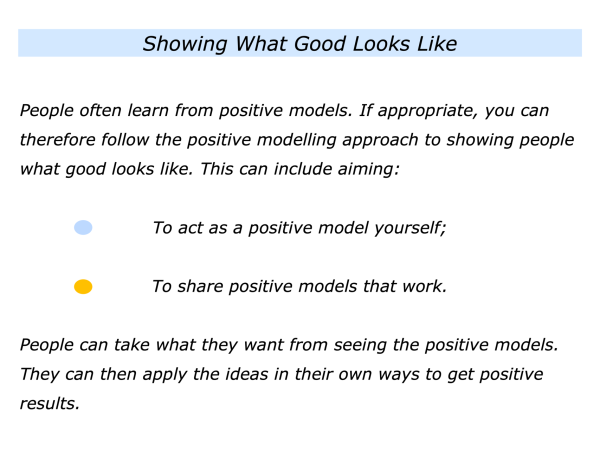
People often learn from positive models. If appropriate, you can therefore follow the positive modelling approach to showing people what good looks like. People can then take the ideas they like and apply these in their own ways.
The follow section describes several ways to follow the positive modelling approach. You will, of course, follow these in your own way.
The Acting As A
Positive Model Approach
Some people aim to do this in their own lives and work. They aim to follow the positive modelling approach rather than the preaching approach.
Such people often aim to be positive and predictable rather than negative and unpredictable. They also often aim to create encouraging environments in which people can grow.
Some individuals become what Harry Stack Sullivan, the psychiatrist called – in the original meaning of the phrase – significant others. They may be parents, grandparents, teachers, coaches or others who play a significant role in our lives.
Such people may also act as positive models. They aim to embody moral principles rather than moralise to others. They demonstrate ways of behaving that we can follow in our lives and work.
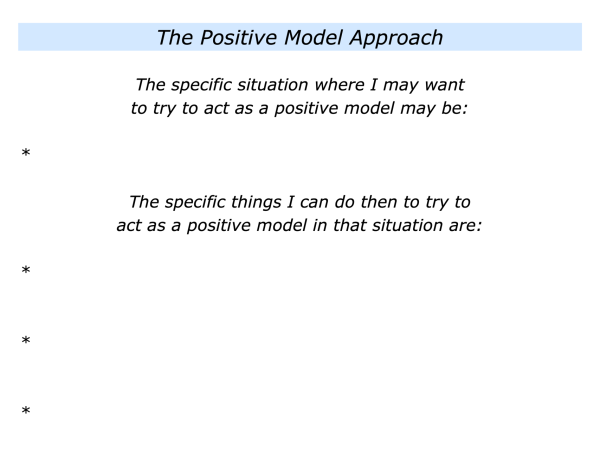
Let’s return to your own life and work. Can you think of a specific situation where you may want to try to act as a positive model? This could be in your personal or professional life.
If you wish, try tackling the exercise on this theme. This invites you to complete the following sentences.
The Sharing Positive
Models That Work Approach
Some pioneers follow this approach. They may do this by sharing positive models that work and possible ways forward in education, medicine, sport, business and other fields.
They may do this by producing articles, films or using other media in a way that resonates with people. People can then take the ideas they like and use these in their own ways to achieve success.
Good educators may also follow this approach. Such people aim to study what works, simplify what works – in a profound way – and share what works.
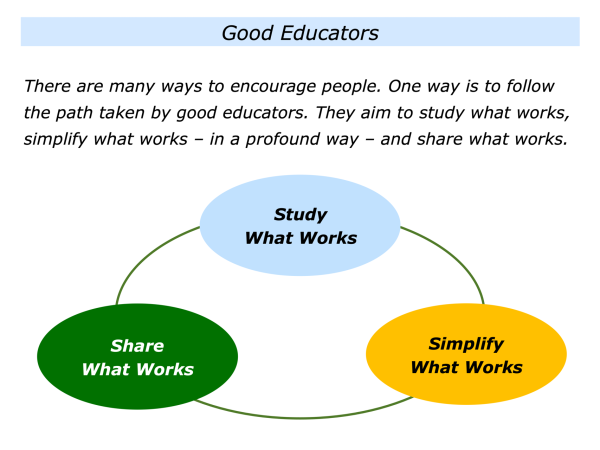
Imagine that you want to follow this approach in your own way. You may then want to apply what you learn either: a) to reach your own goals; b) to help other people to reach their goals. This can involve exploring the following steps.
Studying What Works
The approach starts by focusing on a specific topic you want to learn about. Depending on your interests, you may want to explore one of the following themes.
I want to learn about:
How to be a good counsellor … How to help troubled teenagers … How to help people to build on their strengths and do satisfying work … How to transform a negative culture into a positive culture … How to lead successful teams.
Imagine you have chosen the topic you want to explore. Bearing this in mind, you can ask yourself the following questions.
What is the specific activity that I want to explore? What works in this activity? How can I study success? When have people done superb in this activity? What did they do right then? What were the principles they followed? How did they translate these into action?
How can people follow these principles – plus maybe add other skills – in their own way? What are the key strategies they can follow to increase the chances of achieving success?
Sports psychologists often apply a similar approach. They ask athletes to recall their best performances and what they did right. They then help athletes to focus on how they could follow these principles – plus maybe add other skills – in the future.
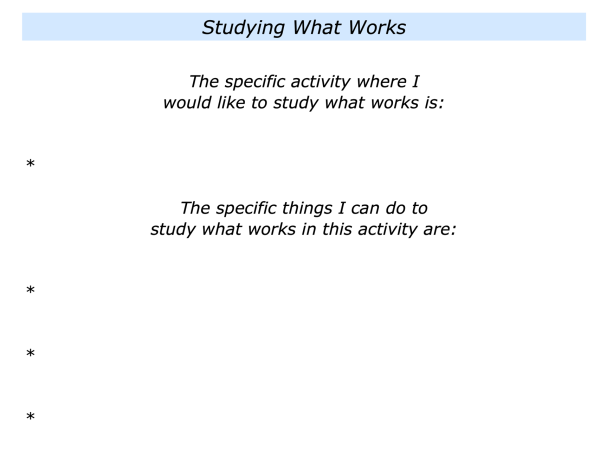
If you wish, try tackling the exercise on this theme. This invites you to do the following things. First, to describe the specific activity where you would like to study what works. Second, to describe the specific things you can do to study what works in this activity.
Simplifying What Works
Imagine that you have focused on a specific activity you want to learn about. The next step may be to simplify what works but to do this in a profound way. How to make this happen?
Great educators look for patterns in a specific activity. They take the following steps to study and simplify knowledge in a particular field.
They focus on what people do right – the successful patterns they follow – to achieve their picture of success;
They translate these patterns into principles that people can follow to achieve their picture of success;
They provide practical tools that people can use to follow these principles in their own ways to achieve their picture of success.
Great workers often demonstrate simplicity in action. A great dancer, footballer or artist can make executing the most difficult skill look deceptively easy. They make complicated things look simple. This is the result of combining their natural talent with years of practice.
Great educators who know their subject often demonstrate the second simplicity. Getting to the heart of the matter, they say things that are simple yet profound.
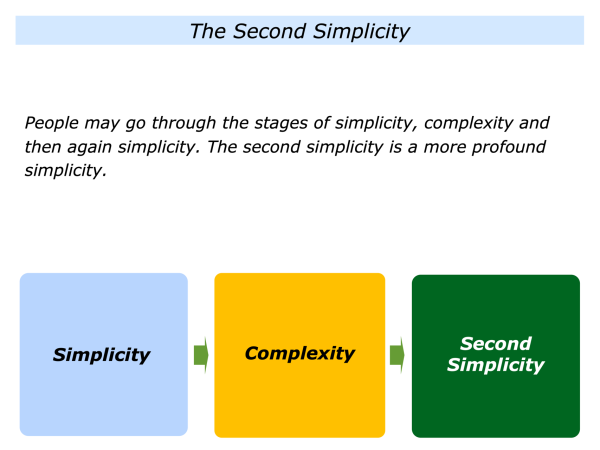
People sometimes go through the following stages in life: simplicity, complexity and then the second simplicity. Let’s explore these themes.
Simplicity
They start by seeing life – or the activity in which they are talented – as simple. Speaking with bravado, they state clearly what they believe to be true. Passionate about these beliefs, they demonstrate the idealism and confidence of youth.
Complexity
They may then enter the age of complexity. Gathering information, they become experts and speak in a more complex language. Sometimes they over-analyse. This does not help them or other people. Whilst still performing well, they feel something is missing.
Second Simplicity
Overcoming challenges, they enter another dimension. They may return to their original philosophy, but experience has brought wisdom. The pains and pleasures of life bring an extra timbre to their voice.
The second simplicity is a profound simplicity. Speaking from the depths of their being, their words resonate more deeply. They have wisdom in their bones.
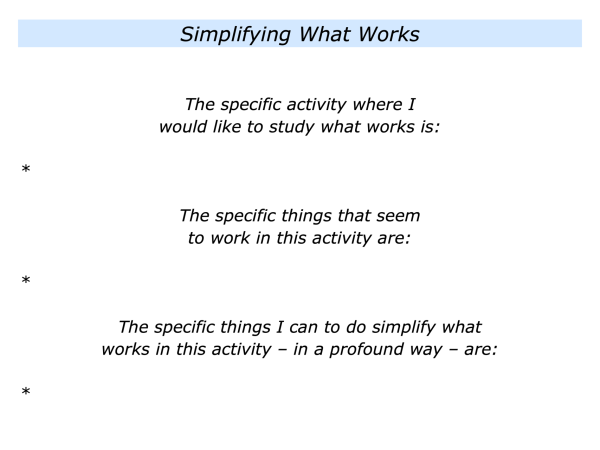
Bearing in mind the activity you want to study, try tackling the exercise on this theme. Describe the specific things you can do to simplify what works in this activity.
Sharing What Works
Imagine that you have clarified what works in a specific activity. You may want to apply this knowledge to reach your own goals. Alternatively, you may to share what works to help other people to succeed.
Imagine that you want to take this second route. One approach is to focus on the What, Who, Why, How and When.
The What
What is the specific activity you have studied? What works in this activity? What are the reasons why you may wanted to focus on this activity? What is the knowledge you want to pass on to people?
The Who
Who are the people you would like to reach? What are the characteristics of these people? Would they be young people, budding entrepreneurs, athletes, leaders, social entrepreneurs, therapists or other people?
The Why
Why would you like to pass on this knowledge? What would be the benefits for people? How can they use the knowledge to tackle challenges or achieve their goals?
The How
How would you like to share your knowledge with people? Bearing in mind your strengths, would you like to write articles, teach, run workshops, coach, mentor, make films or use another media?
The When
When do you want to share the knowledge with people? What would be the preferred setting or situation for passing on the ideas? How can you find or create a situation for passing on the knowledge?
Good educators often aim to study what works, simplify what works and share what works. You will follow these principles in your own way.
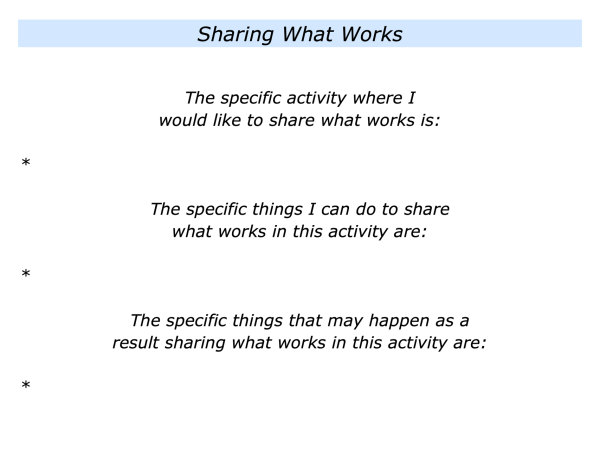
If you wish, try tackling the final exercise on this theme. This invites you to describe the specific things you can do to share what works with people. Here is the exercise.
The Successful Prototypes Approach
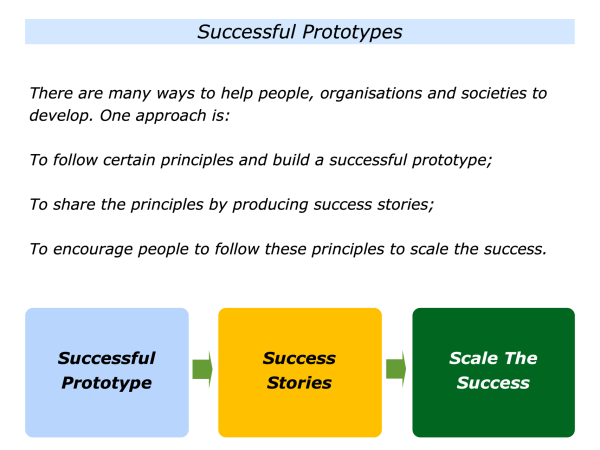
There are many ways to help people, organisations and societies to develop. One approach is to remember that:
People buy success rather than the theory of success.
Bearing this in mind, it can be useful to demonstrate success. When appropriate, this can involve aiming:
To follow certain principles and build successful prototypes;
To share the principles by producing success stories;
To encourage people to follow the principles in order to scale the success.
This is an approach I was taught early in my career. At the time a lot of the work involved change programmes. The real aim, however, was:
To help people, teams or organisations to achieve their picture of success.
Bearing this in mind, we aimed: a) to study what worked; b) to show what worked; c) to share what worked. It was then up to people to decide whether they wanted:
To follow these principles in their own ways;
To work towards achieving their picture of success.
It was important to show people what worked and the benefits. They could then decide if they wanted to follow the principles.
When appropriate, we then worked alongside these people. The aim was to encourage, educate and enable them to achieve their picture of success.
Imagine that you want to follow the building prototypes approach in your own way. You may be aiming to show how it is possible for people:
To have an inspiring education … To provide great service to customers … To solve a specific problem … To build a positive organisation … To do certain projects that show how people in society to achieve success.
Let’s assume you have chosen to build a certain kind of prototype. It can then be time to move into action.
You can follow certain principles
and build a successful prototype
People who build successful prototypes often follow certain rules. Here are some you may want to bear in mind when doing your chosen work.
You can clarify the principles you want
to follow to build the successful prototype
People who build prototypes often want to demonstrate that it is possible to follow certain principles to deliver success. Here are some examples.
An educator may aim to show it is possible to follow certain principles to help students to learn.
A business person may aim to show it is possible to follow certain principles to create a new form of banking.
A leader may aim to show it is possible to follow certain principles to build a successful company.
Imagine that you have an idea about the kind of prototype you want to build. You can also begin to focus on:
The specific principles you want to follow when building the prototype;
The specific ways these can be translated into action to deliver success;
The specific benefits of building such a successful prototype.
Let’s assume that you have done some initial work on these themes. It will then be time to focus on the next step.
You can clarify the picture of success
Imagine that you aim to build a prototype. You may aim to build a certain kind of school, shop, service, product or achieve another goal. Bearing in mind the principles you aim to follow, it can be useful:
To clarify the things you can control in the situation;
To clarify the real results you want to achieve – the picture of success;
To clarify the actual words that you would like the various stakeholders to be saying about the successful prototype.
These were the steps taken by Kate, a customer service director, that I worked with many years ago. Hired by a famous financial organisation, she was given a clear remit. This involved aiming:
To create the new kind of call centre on a green field site;
To employ people who had a good customer service ethic;
To create a positive environment in which they could do superb work;
To build a reputation for great customer service whilst also hitting its financial targets;
To create a model that could be followed by other parts of the business and enable the organisation to achieve ongoing success.
Imagine that you have clarified the results you want to achieve by building the successful prototype. It can then be useful to focus on the following step.
You can do your best to
set things up to succeed
Sometimes this it is relatively easy to take this step. Looking at the work done by Kate, for example, she had the following advantages:
She was hired to create the call centre and was given the required backing;
She made clear contracts with the key stakeholders about the results to achieve – the picture of success;
She had the authority to do what was required to deliver success.
Sometimes this process can be more challenging. Bearing this in mind, let’s look at another approach to setting things up to succeed.
Imagine that you want to build a prototype to demonstrate a new way of working. This may aim to provide wins for the company, wins for the customers and wins for the colleagues. Let’s explore how to make this happen.
You can start by getting backing from the key stakeholders. It will be important:
To show how the approach will benefit the company;
To make clear contracts about the agreed picture of success;
To set things up to increase the chances of delivering success.
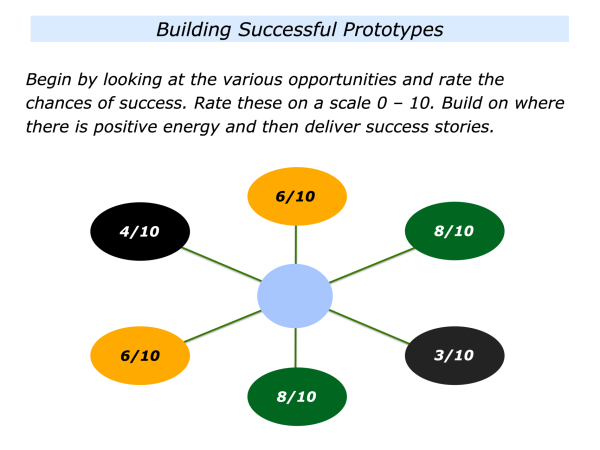
This final point is crucial. Imagine you work for a global business. Looking around the organisation, identify where you would stand a good chance of building a successful prototype.
This could be a green field site, team, department or country where there is fertile ground. Make sure the rating is at least a 7+/10 chance of success. You can then focus on this particular area and do everything possible to set things up to succeed.
Let’s assume that you have gone through these steps. It will then be time to move on to the next stage.
You can build the successful prototype
You can do your best to build the successful prototype. Much will depend, of course, on the type of work you are doing. Looking at my own work, I have cooperated with people who have aimed:
To create a successful therapy programme … To develop a wellbeing programme inside a company … To build a superb call centre … To build a pacesetting digital company … To build many other kinds of prototypes.
You will build the prototype in your own way. Bearing this in mind, however, you may want to consider some of the following steps. You can aim:
To implement the right strategy with the right people in the right way;
To get some early wins, encourage people on the journey and do superb work;
To find solutions to challenges and do your best to deliver the desired picture of success.
Kate took these steps when creating the call centre. She communicated the call centre’s purpose, principles and picture of success. She then recruited people who loved helping customers. They were positive, professional and problem solvers.
Kate made clear contracts with people about their best contributions towards achieving the goals. She then managed by outcomes rather than by tasks. She kept people informed about the progress being made.
Gathering the teams together every months, she encouraged them to focus on:
The Picture Of Success. The specific
results we are aiming to deliver are:
*
*
*
Doing Well. The specific things that we are doing well – and
how we can do more of these things – to deliver the results are:
*
*
*
Can Do Better. The specific things we can do
better – and how – to deliver the results are:
*
*
*
Imagine that you have built a successful prototype. Some people finish at this point but others go further. Let’s explore this next possible step.
You can share the principles
by producing success stories
Great workers often pass on their knowledge to other people. They do this in education, medicine, science and many other fields. They aim to share what worked and what can be improved in the future.
Imagine that you want to do this in your own way. There are many ways to produce success stories. You may do this by writing an article, creating a video or using another media. Here is one approach.
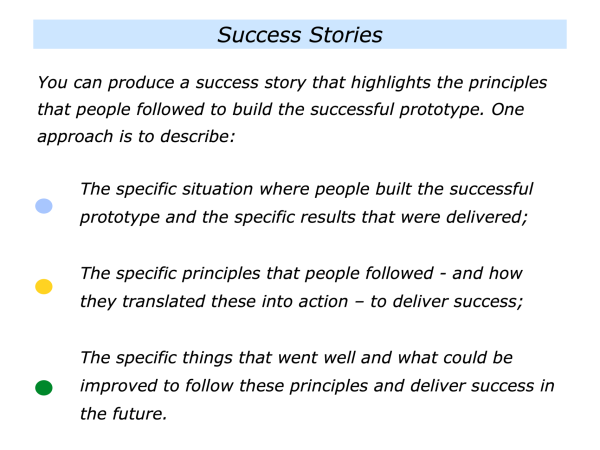
There are several points to bear in mind when producing such a story. But you can cover these in your own way.
First, it is important to set the scene and give the context. You may have been tackling a challenge, creating a product or do another activity that could help the organisation to shape a positive future.
Second, to focus on the principles that people followed to deliver success. This helps to increase the likelihood of others following these principles in their own ways.
Third, to be humble. This involves giving other people the credit for doing the work. It also involves focusing on what went well and what could be improved in the future.
Imagine that you have produced such a success story. If appropriate, you may want to move on to the next stage.
You can encourage people to follow
these principles to scale success
Many leaders will support the idea of building successful prototypes. Some then ask the following question:
“How can you scale the approach? How can you get people to learn from the prototypes and apply the ideas to deliver ongoing success?”
Great organisations are often principles driven rather than personality driven. They may be founded by people who have strong personalities but this can be hard to scale.
Great organisations encourage their employees to follow certain principles. People can then use their personalities to translate the principles into action, scale the work and deliver success.
Different organisations take this steps in different ways. Some follow the three waves approach. This involves going through the following stages.
The First Wave
This is to follow certain principles to build successful prototypes and produce success stories.
The Second Wave
This is to encourage motivated people who want to follow the principles and to enable them to deliver success.
The Third Wave
This is to make the principles mandatory and provide people with the support they need to deliver ongoing success.
Different people build different kinds of prototypes. Sometimes the lessons they provide are followed by other people in an organisation. Sometimes the lessons are put aside and not used.
Sometimes the lessons are picked up by other people in other places. They follow the rule that sometimes it is better to go second. Such people then apply the learning in their own ways to deliver success.
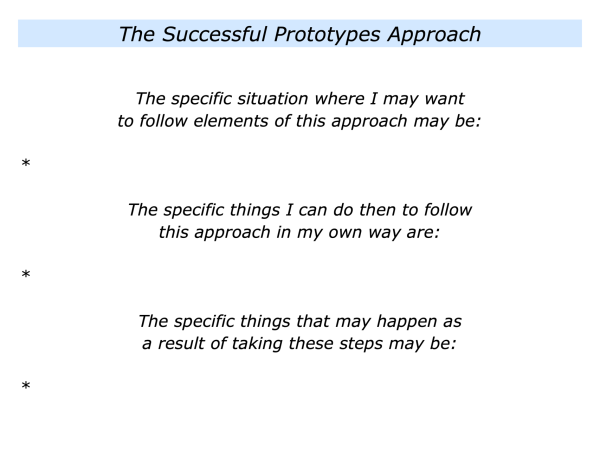
Let’s return to your own work. Looking ahead, can you think of a situation where you may want to follow elements of the building successful prototypes approach? How can you do this in your own way?
If you wish, try tackling the exercise on this theme. This invites you to complete the following sentences.
The Success Stories Approach
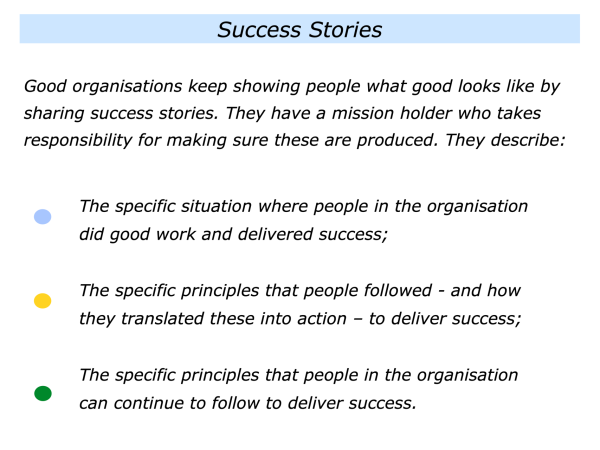
There are many ways to show rather than just tell when building and maintaining an organisational culture. One approach is to keep producing success stories. These can encourage people to keep following the principles for achieving success.
This approach works well in principles driven organisations because it keeps showing people what good looks like. It can also be used by organisations that want their people to follow certain strategies and perform superb work.
One key point is worth underlining. It is important to have a mission holder who takes responsibility for collecting and publishing these stories. Whilst they don’t have the do the writing themselves, they need to keep producing these stories.
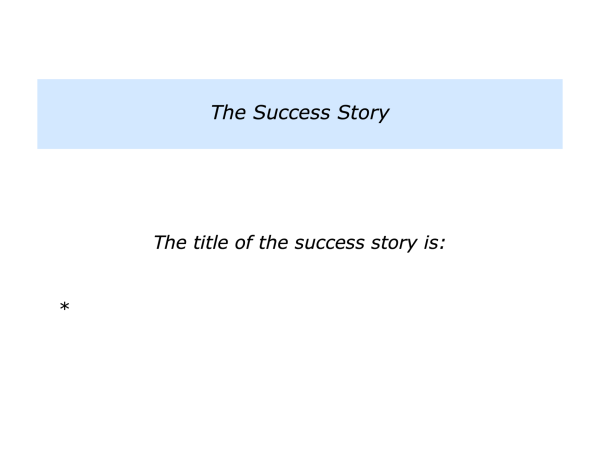
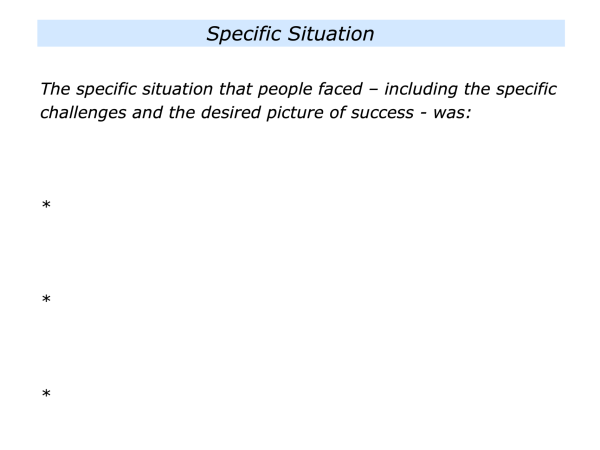
There are many ways to write such stories. One approach is choose a title for the story. It is then to describe the specific situation that people encountered.
People could be helping a client, solving a problem, making systems work better or whatever. It is to describe the challenges they faced and the desired picture of success.
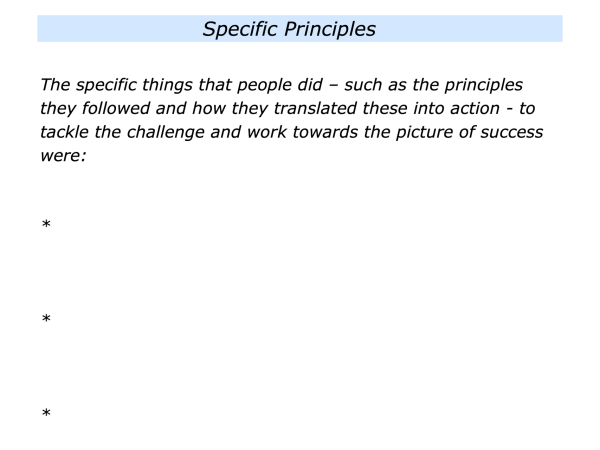
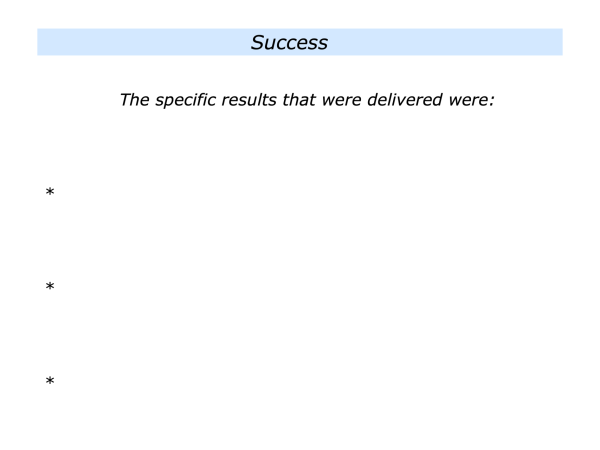
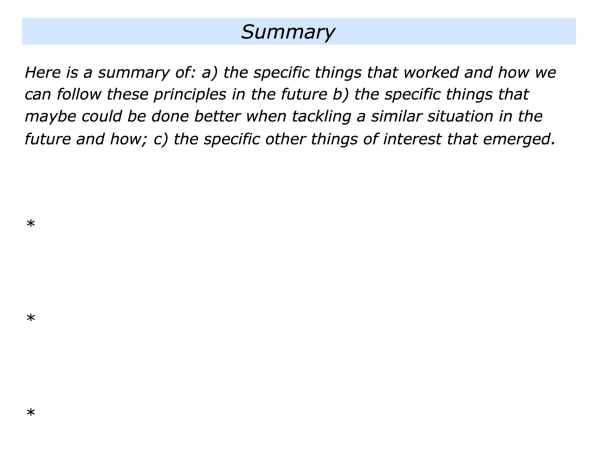
The next step is to describe the strategies – such as the principles – that people followed and how they translated these into action. It is then to describe the results that were delivered to achieve the picture of success. Plus it can be good to summarise what was learned from the experience. .
As mentioned earlier, there are many ways to produce such stories. Here is one framework that people can follow in their own way.
There are many ways to encourage people to focus on shaping a positive future. One approach involves following the old rule that it is important to show rather than just tell. This is because:
People buy success rather than the theory of success.
As mentioned earlier, there are many ways to follow this approach by acting as a positive model yourself or by sharing positive models that work.
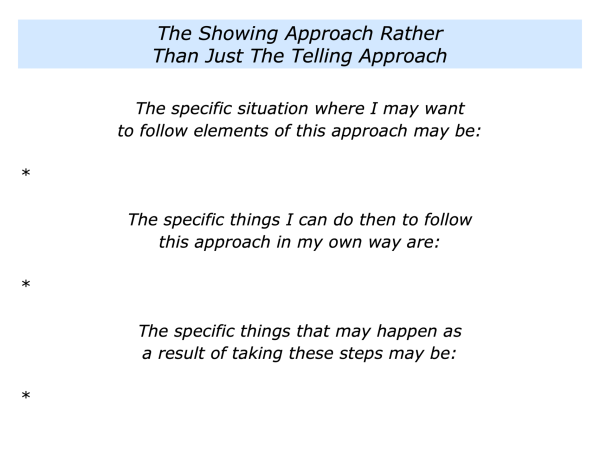
Let’s return to your own life and work. Looking ahead, can you think of a situation where you may want to follow elements of the showing approach rather than just the telling approach? How can you do this in your own way?
If you wish, try tackling the exercise on this theme. This invites you to complete the following sentences.

Leave a Reply