



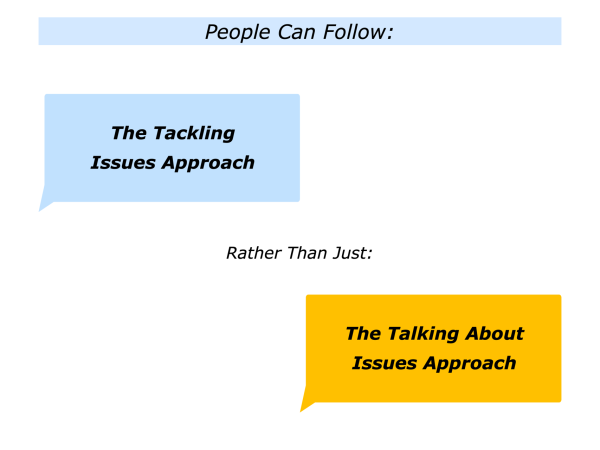
There are many ways to live life. Some people follow the tackling issues approach rather than the just talking about issues approach. Such people gather information and then focus on the following steps.
Clarity – They clarify the real results to achieve and translate these into a clear picture of success.
Creativity – They clarify the strategies they can follow to give themselves the greatest chance of achieving the picture of success.
Concrete Results – They clarify their action plan and then do their best to achieve the picture of success.
Such people recognise there may be situations where they must act immediately to stop the haemorrhaging. They then move on to clarifying the strategies they can follow to achieve the short, medium and long-term goals.
Some people instead sspend their lives talking about issues and never tackle the challenges. They may do this as individuals, groups or organisations. They seldom move into action to deliver success.
Imagine that you want to follow the first approach. Let’s explore how you may aim to translate this into action.
The Tackling Issues Approach
Let’s start by exploring your own experiences. Looking back, can you think of a situation when you tackled an issue successfully? You may, for example, have tackled some of the following challenges.
How to recover my zest for life … How to find a job after my employer went bust … How to manage an alcoholic relative and their behaviour towards our family.
How to take the next step in my career … How to deal with a micromanaging boss … How to help our daughter to build on her strengths rather than be defined by the school.
How to do our best for our parents as they get older … How to help the organisation I lead to shape a positive future … How to focus on the things that are important rather than be overloaded by events in the world.
Imagine that you have chosen to focus on an issue that you have tackled successfully. What did you do right then to tackle it successfully? What were the principles you followed? How did you translate these into action?
You will, of course, have followed your own approach. If appropriate, however, you may want to explore some of the following themes and how you translated these into action.
Clarity
What was the specific issue that you chose to tackle? What did you do to gather information about the situation? What were the reasons why you then decided to do something about the situation?
What were the specific things you could control in the situation? Bearing these in mind, what were the real results you aimed to achieve in the situation? What was the picture of success?
Creativity
What were the possible options you could pursue in the situation? What were the pluses and minuses of each option? What was the attractiveness rating – on a scale 0-10 – of each option?
What did you then do to explore any other potential creative solutions? What did you do to study success and clarify what had worked – either for yourself or other people – in similar situations?
Concrete Results
How did you settle on the route to follow? How did you clarify the strategies you could follow to increase the chances of success? How did you rehearse following these strategies plus managing any challenges?
How did you translate the strategies into action? How did you aim to get some quick successes? How did you encourage yourself on the journey? How did you then do your best to achieve the picture of success?
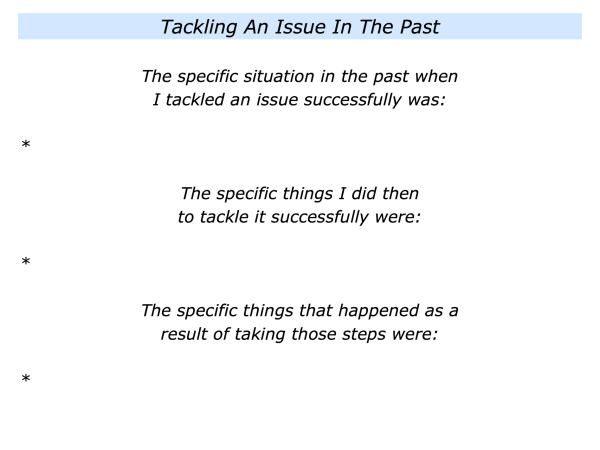
There are many ways to tackle issues. You will, of course, have your own approach. If you wish, however, try tackling the exercise on this theme. This invites you to complete the following sentences.
The Just Talking
About Issues Approach
Some people spend much of their lives talking about issues and never tackling the challenges. Different people do this in different situations in their lives.
Some people do this in their personal lives. They focus on their angst rather than appreciating life. They describe how their problems stop them from being happy or how others are to blame.
Such individuals may have an external locus of control rather than an internal locus of control. They may say: ‘Things happen to me,’ rather than: ‘I can make things happen’.
Some people are also addicted to talking about problems in the world. They may also keep talking about these with other people and pass on their angst.
Some people follow this approach in their professional lives. They may do this by playing the role of observer critic, devil’s advocate or another role where they do not have to present practical solutions.
Some do this in by being politicians who loves to criticise others but never produced solutions during their time in office. Some go into their default mode of always trying to prove a point rather than trying to help things to improve.
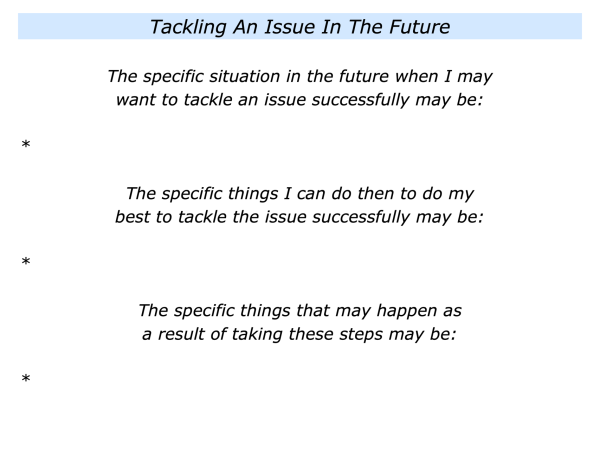
Let’s return to your own life and work. Looking ahead, can you think of an issue that you may want to tackle successfully? This could be in your personal or professional life.
Bearing in mind what you can control in the situation, what may be the results you want to achieve? How can you do your best to achieve these results? What may happen as a result of taking these steps?
If you wish, try tackling the exercise on this theme. This invites you to complete the following sentences.

Leave a Reply