



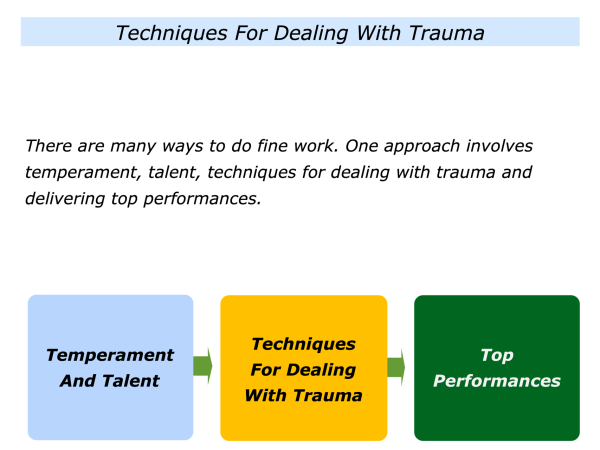
There are many ways to do fine work. One approach involves temperament, talent, techniques for dealing with trauma and delivering top performances.
Imagine that a person has the ability to deliver fine work but may also need to be able to deal with emotionally challenging situations. Let’s explore some themes to explore when helping them to deliver the goods.
Temperament
Great workers have the temperament required to do their chosen work. Different kinds of work, of course, require people with different temperaments.
A paramedic needs to be calm in distressing situations. A salesperson needs to be motivated and resilient. An athlete needs to manage pressure and rise to the occasion.
Let’s assume that a person has the temperament required to do their chosen work. This leads to the next stage.
Talent
Talent is a prerequisite for doing great work. A footballer needs certain skills to play in a specific position. A doctor needs medical skills, people skills and, in some cases, organisational skills to run a good practice.
A leader needs to be able to make good decisions and implement the right strategy with the right people in the right way. They also need to build a positive culture in which motivated people do superb work.
Let’s assume that a person has the talent required to do their chosen work. This leads to the next stage.
Techniques For
Dealing With Traumas
People who do different kinds of work may experience different kinds of successes and setbacks. Sometimes they will build on getting top class results. Sometimes they may experience certain kinds of traumas.
Sometimes they may encounter setbacks that may be disappointing but not too dramatic. There may be other situations, however, where the experience can be more traumatic.
Great workers recognise this before entering their chosen profession. They may do this when working as a paramedic, bomb disposal expert, crisis manager or doing another role that can be challenging.
Some people may not be fully aware, however, of some situations they may meet. A young footballer may only focus on the potential triumphs rather than the challenge of injuries or missing a vital penalty in a shoot-out.
There are many techniques for dealing with different levels of trauma and much depends on the situation. Losing a football match can be painful but is little compared to losing a limb or losing a loved one.
The use of the word ‘technique’ is deliberate. This is because trauma can produce both physical and psychological reactions. Whilst acknowledging these feelings, sometimes it can be useful:
To provide people with a practical tool they can use to channel their emotions in a productive way.
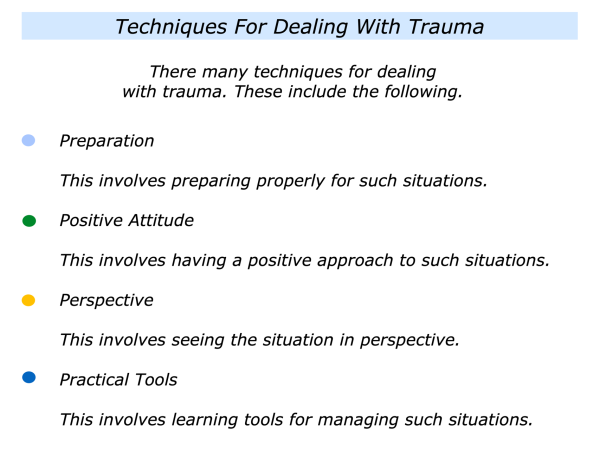
Here are some of the techniques that a person can use to deal with potential traumas. There may, of course, be extreme situations where they may also need professional physical or psychological support.
Preparation
Great workers do their due diligence and prepare properly before embarking on the work. They clarify what they are getting into and, as far as possible, explore every eventuality.
Different people do this in different ways but many go through the following steps.
They clarify the real results they want to achieve and the strategies they can follow to give themselves the greatest chance of achieving the picture of success.
They clarify the potential pluses and minuses involved and, bearing these in mind, their motivation rating – on a scale 0-10 – to do what is required to achieve the picture of success.
They clarify the specific things they can do to translate the strategies into action by rehearsing following the strategies and managing any challenges on the way to achieving the picture of success.
Great workers also do whatever is possible to set things up to succeed. This involves taking steps to manage any successes and setbacks – including how to deal with potential traumas – on the journey.
Imagine that a person has prepared properly. Whatever they have planned, however, sometimes there may be challenges along the way. Let’s consider how some people manage these situations.
Positive Attitude
Great workers are often positive realists rather than starry-eyed optimists. They have a positive attitude but are also good at reading reality. They take the following steps when encountering a challenge.
They often talk about controlling the controllables. They aim: a) to build on what they control in a situation; b) to manage the consequences of any things they can’t control.
Such workers also have a positive approach to managing setbacks. One Formula 1 driver described how they understood the rewards and risks in their sport. They then said something along the following lines.
“My goal is to continually improve. Sometimes it is hard to win races because you may not have the fastest car. This sounds odd, but these days I also see any mistakes I make as giving me a chance to improve.”
Perspective
Some people find a way to manage traumas by seeing these in perspective. Much depends on the kind of trauma, of course, but there are different ways to help people to take this approach.
One approach is to invites a person to clarify their assets and the really important things in their life. These may include being healthy, caring for their loved ones and focusing on their longer-term life goals.
Sports psychologists sometimes take this approach with professional athletes who may focus only on winning. Concentrating on winning sounds logical, but it can be counter-productive and lead to them tightening up at crucial moments.
Some athletes can actually perform better when: a) they do fine work to get to 8/10; b) they then go into a flow state and use their talent to deliver top performance.
Sports psychologists sometimes help an athlete to take this step by helping them to concentrate fully when playing their sport. But also being able to see this in perspective.
Some coaches take another approach to helping teams to manage challenging situations. They invite speakers who have either: a) managed traumas in their own lives; b) manage traumatic situations in their daily work.
The athletes learn from people who experienced personal challenges and from professionals whose work involves manage daily traumas. This can help to put their own challenges in perspective.
Certainly it can help to see how a trauma may fit into a wider context, but this may still not help some people who are experiencing difficulties. This leads to the next approach.
Practical Tools
People often want practical tools they can use to manage challenges and channel their emotions in a positive way. There are many techniques that people can use. These include the following.
Positive History
This approach involves a person recalling a time when they managed a similar situation successfully. What did they do right then? What were the principles they followed? How can they follow similar principles – plus maybe add other skills – to manage the present situation successfully?
Deep Breathing
This is the classic approach and can also be effective. It is often used by footballers, for example, before taking a penalty. The aim is to breathe deeply relax and refocus. It is then to flow and aim to finish properly.
Managing Triggers
This involves a person recognising trigger situations where they may react by going into a downward spiral. It is then for them to buy time to think, clarify their options and follow the option that is most likely to produce positive results.
Being Positively Present And
Parking Other Emotions Till Later
This is an approach used by golfers after hitting a bad shot. They have a personal mantra they use to stay fully in the present. They park any anger or other feelings they may have until after finishing their round.
Top Performances
There are many models for taking this step. Some may involve a person going into their equivalent of the zone. They may aim either:
To build on their strengths, follow strategies that work and do their best to achieve their picture of success;
To pursue a specific purpose, follow their principles and achieve peak performance;
To flow, focus, finish and, as a by-product, experience a sense of fulfilment.
Another approach is for a person to have the right temperament and talent. They may deal with certain kinds of trauma. They may then aim to take the following steps towards delivering top performances.
Tactics
Great workers clarify the strategies most likely to deliver success. They then clarify the specific actions they will take to implement the strategies and perform top class work.
Here we are using the term tactics to include both the strategic elements and the specific actions. Depending on their work, different people will adopt this approach in different ways.
Great workers often make good strategic decisions about the specific activity they will pursue. They put themselves into a place where they can play to their strengths and do superb work. They then do their best to deliver success.
Tenacity
Great workers demonstrate tenacity. They may do this when aiming to develop a skill, continue to improve or overcome challenges to reach a goal.
Such people show grit, persistence and resilience. They put in the effort required to improve their mentality and technique on the way to doing tremendous work. Let’s look at one example.
Wayne Gretzky, the great ice hockey player, described how he took this route. Talking with Michael Murphy for the book In The Zone, he explained how he practiced during his childhood.
“I’d get up in the morning, skate from 7.00 to 8.30, go to school, come home at 3.30, stay on the ice until my mom insisted I come in for dinner, eat in my skates and then go back out until 9.00.
“On Saturdays and Sundays, we’d have huge games, but night time became my time. It was sort of an unwritten rule around the neighbourhood that I would be out there by myself or with my dad.
“I would just handle the puck in and out of those empty detergent bottles my dad set up as pylons. Then I’d set up targets in the net and try to hit them with forehands, backhands, whatever. Then I’d do it all again, except this time with a tennis ball, which is much harder to handle.
“I was so addicted that my dad had big kids come over to play against me. When the kids wanted to go home, I’d beg them to stay longer.”
Such workers see every day as an opportunity to improve. Sometimes this involves demonstrating tenacity – persistence and determination to reach a specific goal.
Trusting Their Talent
Great workers put in the work needed to get to 8/10. They may then aim to relax and trust their talent. This enables them to make better use of their strengths to deliver top performances.
Robert Lewandowski, the Polish centre forward, has scored many goals in his career. He recalled a conversation he had with Pep Guardiola, his coach at Bayern Munich, and asking how he could improve as a striker. Pep gave an answer along the following lines.
“You are playing superbly by following many of the team’s strategies and getting into the penalty area. When you get there, you know more about how to score than I do. Use your instincts and the goals will come.”
Christian Horner, once Principal of the Red Bull Formula 1 Team, described how he wanted one of his drivers to trust their talent. Here is a summary of what he said.
“This driver is extremely talented, but sometimes he crams too much information into his head. He needs to prepare properly but then let his instinct take over.
“Great drivers have that edge. They rehearse the race ahead of time and then apply their natural flair to perform superbly at critical moments.”
Great workers spend years building on their strengths and developing skills for managing their weaknesses. Preparing thoroughly, they clarify their strategies for dealing with many different situations.
On some occasions, however, they may hit a block. They over-think things, try too hard or tighten up in stressful situations. They may become over-critical and get into a downwards spiral. Top performers may then follow their chosen ritual to calm themselves.
Matt Lloyd, the climber and writer, explores this approach in an article he wrote called The Mind Game: How To Overcome Fear. He begins the article by referring to a near-death experience he had when climbing.
Matt recalls how dealing with it called for staying calm, doing the basics and then trusting his technique and talent. Here he describes some of the tools he learned for managing fear.
Be Prepared
When you’re prepared and well-practiced, you have no reason to doubt yourself. It’s not about closing your eyes and jumping into the unknown.
It’s about having eyes wide open to the dangers around you but knowing that you’re as ready as you can be. Trust in your training and preparedness will give you the required confidence to apply your skills to the task at hand.
While performing, the pros work consciously and in the current moment. They focus on the task at hand rather than the outcome, staying present rather than thinking too far into the event or about the finish.
Matt then builds on some of the ideas he learned from Lisa Lollar, a sports psychologist.
Visualization
Use this as much as you can before you even get off the ground, while lying in bed at night or driving to the crag. The basic idea is to imagine and clearly see yourself completing each move with ease. Go through each move step by step from bottom to top.
Centering
Best done right after coming out of the initial fear flood, it involves paying conscious attention to breathing and bodily sensations. Centering helps the athlete stay in the moment and release past and future thoughts, worries, and plans.
Self-Talk
Use this at any time to quiet the amygdala, awaken the prefrontal cortex, and regain your calm. Either out loud or in your head, talk to yourself. Make it simple: “I’m fine” or “I can do this” or “I got it.”
On a recent 5.11 free solo in Golden, Colorado, I sat at the bottom of the climb thinking about how quickly panic sets in. I then imagined myself handling that experience calmly, breathing deeply, and saying to myself, Relax, you can do this.
I still get scared – hell, what climber doesn’t? – but now I’m better equipped to keep my cool, and that’s made all the difference.
There are many ways to do fine work. One approach involves having the right temperament and talent. It can then involves using techniques for dealing with trauma and delivering top performances.
Let’s return to your own life and work. Looking ahead, can you think of a situation where you may want to follow elements of this approach? This could be for yourself or when helping another person.
What may be the specific situation in your personal or professional life? How could you follow this approach in your own way? What may happen as a result of taking these steps?
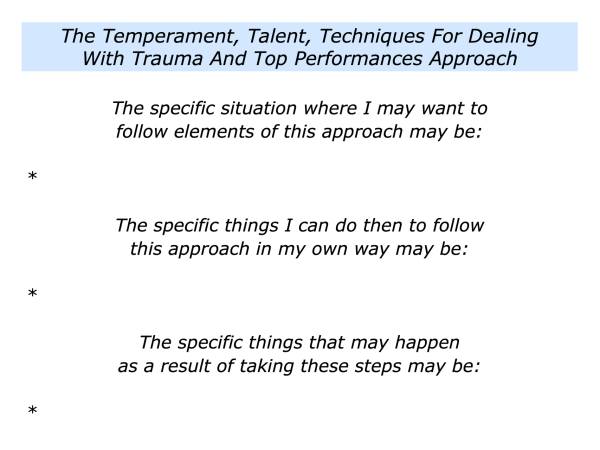
If you wish, try tackling the exercise on this theme. This invites you to complete the following sentences.

Leave a Reply