



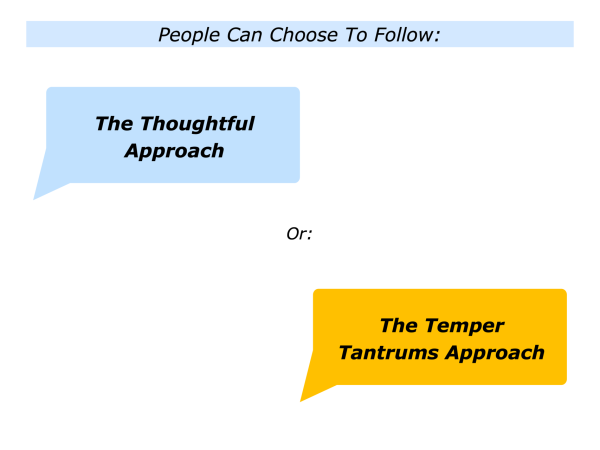
There are many ways to behave in challenging situations. Some people follow the thoughtful approach. Some follow the temper tantrums approach.
People who follow the thoughtful approach often think through things in a caring, considered and sometimes creative way. Those who follow the temper tantrums approach may do this in a combustible way.
Different people follow these approaches in different situations. Some do so in their daily lives. Some when acting as leaders, trusted advisors or in other roles. Some when acting as politicians on the world stage.
The approach that people follow can have consequences – both for themselves and other people. Let’s explore these ways of managing challenging situations.
The Thoughtful Approach
People who take this approach think through things in a considered way. They may do this in both personal and professional situations. They do so because they realise that the decisions they take can have implications.
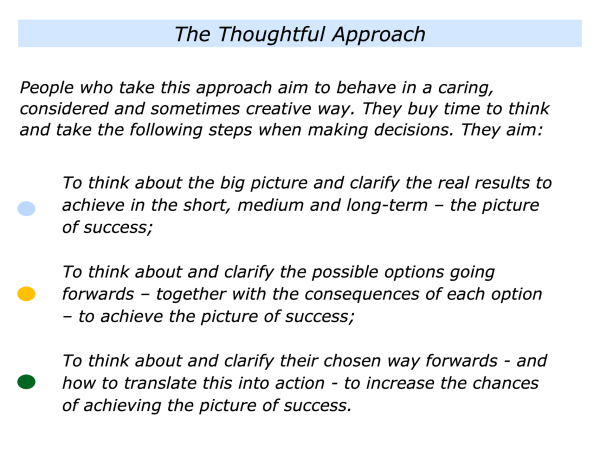
Such people try to buy time to gather information when facing challenges or in other situations. They may then go through the following steps when making decisions.
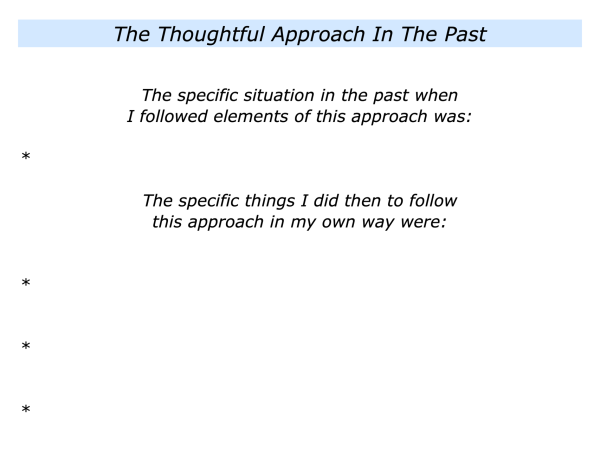
Let’s return to your own life and work. Looking back, can you think of a time when you followed elements of the thoughtful approach? This could have been in your personal or professional life.
What did you do then: a) to consider the big picture; b) to consider the real results to achieve; c) to consider the possible ways forward and the consequences of each option?
You may then have taken time to play the various scenarios in your head. If so, what did you do to explore the possible ways forward and the consequences?
What did you do to settle on your chosen option? How did you then translate this into action? What may have happened as a result of taking these steps?
If you wish, try tackling the exercise on this theme. This invites you to complete the following sentences.
The Temper Tantrums Approach
Different people follow this approach in different situations. Some do it in their daily lives, relationships or work. Some do it when acting as leaders in organisations or on the world stage.
Such people sometimes behave in combustible ways. They believe that their feelings and opinions are paramount. They may then express these in ways that can hurt other people and cause collateral damage.
People who follow this approach often focus only on their own agenda. Some get a kick from expressing their feelings, trying to control others or bullying people.
Such people may or may not consider the consequences of their actions. They often create and tell themselves their own story, however, that continues to justify their behaviour.
Let’s return to the thoughtful approach to making decisions. As mentioned earlier, different people follow this in different situations.
Some military experts, for example, say that such thinking is vital before embarking on a mission. This is preferable to having a gung-ho approach that can result in disaster.
One view is that it is vital for such missions: a) to have clear and achievable specific goals; b) to have clear strategies and the right coordinated support; c) to have a good chance of success and a clear exit strategy.
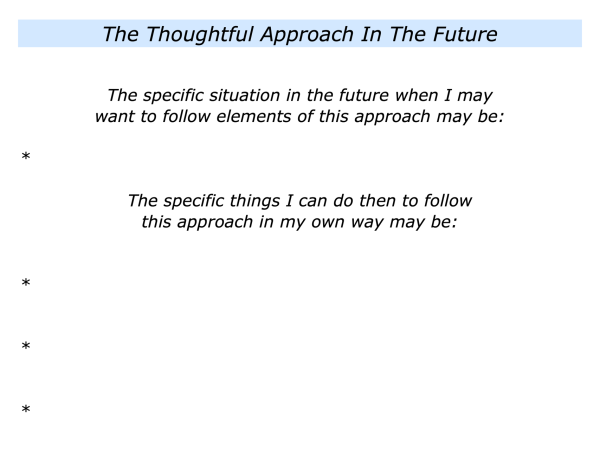
Let’s return to your own life and work. Looking ahead, can you think of a situation where you may want to follow elements of the thoughtful approach? This could be in your personal or professional life.
Bearing in mind what you can control in the situation, what may be the real results you want to achieve? What may be the possible ways forward together with the pluses and minuses of each option?
What may be the option – or the combination of options – you want to pursue? How can you rehearse following the strategy and managing any challenges along the way? How can you then do your best to achieve the picture of success?
If you wish, try tackling the exercise on this theme. This invites you to complete the following sentences.
The Thoughtful
Approach In The Future

Leave a Reply