



The concept of transferable skills became more common from the 1950s onwards. These were highlighted in the work of people such as Theodore Yntema, Bernard Haldane, Richard Bollas and William Bridges.
The approach entered the mainstream in the 1970s. People who attended career development workshops were encouraged to identify their transferable skills. These were:
The skills they used in one activity that
could also be used in another role or career.
The transferable skills approach can be used to help people to do superb work in certain fields. It also comes with caveats, however, because their skills may not be applicable in other fields.
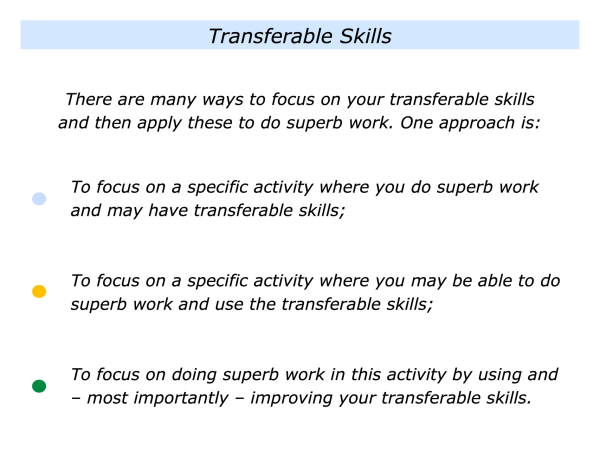
Imagine that you want to explore your own transferable skills. One approach is to focus on the following themes.
You can focus on a specific activity
where you do superb work
and may have transferable skills
There are many ways for a person to find their transferable skills. One approach is to start by focusing on a specific activity where they may do superb work. Different people will obviously explore different activities.
They may focus on when they are encouraging a person, teaching a class, playing a sport, renovating a house, fixing a technical problem or doing another activity.
They may focus on when they are leading a team, coordinating people’s efforts, managing a crisis, performing on stage, selling a product, helping a customer or playing another role.
Imagine that a person is taking this approach. When doing so, it can be useful for them to take the following steps. They can aim:
To focus on the specific activity they were doing – the more specific the better – and what they were doing right to perform superb work;
To focus on the principles they were following – and how they translated these into action – to perform superb work;
To focus on the potential transferable skills they were using – when working by themselves or leading a team – to perform superb work.
Imagine that you want to follow this approach in your own way. You can start by focusing on a specific activity where you did superb work. This could be one in your personal or professional life.
You can focus on an activity you are doing by yourself for when leading a team. As mentioned above, it can be useful to make the example as specific as possible.
Let’s assume you are exploring such an activity. What were you doing right then to perform superb work? What may be the principles you were following? How did you translate these into action?
Different people will highlight different things. Bearing in mind the specific activity you were doing, here is a list of some principles you may have been following to do superb work.
The Specific Activity Where You Did Superb Work –
Some Of The Principles You May Have Been Following
You were building on your strengths … You did something that you felt passionately about … You set a specific goal and translated this into a clear picture of success … You clarified the benefits of achieving the goal.
You clarified the strategies most likely to achieve the goal … You translated these into a clear action plan … You rehearsed following the potential strategies … You rehearsed how to manage any challenges.
You were good at managing any key stakeholders … You made clear contracts with the people about the outcomes to achieve … You then proactively kept them informed about your progress to the goals.
You may then have embarked on doing the work as an individual … You started by getting an early success … You followed the strategies and performed superb work.
You were persistent and resilient … You focused on continuous improvement … You managed setbacks successfully … You also bought time to think in difficult situations and found solutions to challenges.
You followed your successful pattern for finishing … You kept going until you had finished the work successfully … You reached the goal and then added that touch of class.
You may, alternatively, have led a team that aimed to reach a specific goal … You communicated the team’s purpose, principles and picture of success … You made sure that you had the right people in the team.
You aimed to build on people’s strengths … You made clear contracts with people about their best contributions … You gave people the support they needed to perform the part in reaching the goals.
You managed by outcomes rather than by tasks … You encouraged people to perform superb work … You held regular sessions where people updated you on their progress towards achieving their part of the goals.
You shared successes stories that highlighted when people followed the principles to perform superb work … You encouraged people to keep doing their best … You enabled the team to achieve the picture of success.
Imagine that you have explored this exercise. Looking at the principles you followed – and how you translated these into action – it may be useful to consider the following question.
What may be some of your transferable skills?
You may have skills that involve doing something you feel passionately about; setting stimulating goals; following strategies that work; finding solutions and doing work that helps people to achieve success.
You may, of course, have other potentially transferable skills. There may be situations where these are eminently transferable but others where they aren’t. This is something we will explore in the next section.
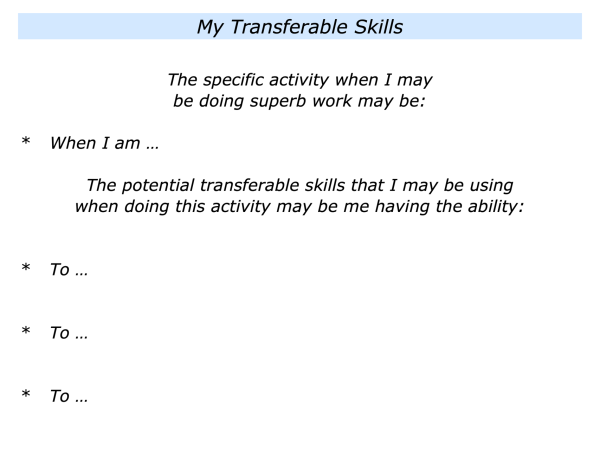
If you wish, however, try tackling the exercise on this theme. This invites you to do to things.
First, to describe a specific activity where you are doing superb work.
Second, to describe the potential transferable skills you may be using when doing this activity.
You can focus on a specific activity
where you may be able to do superb
work and use the transferable skills
Imagine you have clarified your potential transferable skills. You may then begin to explore how you can apply these skills in another activity such as a piece of work, a role or a career.
This is where it is important to mention the caveat. There was a time when people were advised that such transferable skills could be applied virtually any field. But this did not always prove to be the case and some people found the move they made did not work out.
There are several guidelines you can follow, however, to improve the chances of doing superb work. This involves considering the following themes when focusing on a specific activity such as a piece of work, a role or a career.
You can focus on a specific activity
that gives you positive energy
You can focus on a specific activity that, even when you think about it, gives you positive energy. You will go towards it with a spring in your step and want to improve when doing this activity.
Different people will do this when doing different activities. Here are some of the things that people mention when exploring this theme.
Positive Energy
The specific activities – the pieces of work, roles or careers –
that give me positive energy even when I think about them are:
Helping young people to develop confidence … Caring for animals … Doing interior design … Being a trusted advisor to customers … Coordinating people’s strengths and achieving positive results.
Leading projects … Helping retiring athletes to develop new careers … Making things work better … Applying creativity to solve challenges in organisations.
Developing software that simplifies people’s lives … Selling to certain kinds of customers … Raising money for charities … Passing on knowledge that helps people to shape a positive future.
Imagine that you have clarified a specific activity that gives you positive energy. You can then move on to the next step.
You can make sure you have a feeling for
the activity – that you are potentially good
at it – and have a respect for the activity
This is an important step. Looking at the field of activity you have chosen, it can be useful to explore the following questions.
Do you have a feeling for the specific activity? Do you have the ability to be good at it? Do you have a track record of finishing things – small or big things – when pursuing some of the tasks involved with this activity?
Do you respect the deep knowledge required to do the activity? Do you respect the people involved in the activity? Do you respect the work you will need to do to perform superbly in the activity?
Let’s assume that you have been able to say ‘Yes,’ to these questions. You may then move on to the next step.
You can focus on doing superb work in this
activity by using and – most importantly –
also improving your transferable skills
Imagine that you want to move on to doing a specific activity where are able to do two things. First, to use your transferable skills. Second, to be able to do superb work and deliver success.
There are several ways to take this step. These can involve you focusing on the following themes.
You can start by doing a specific
project in the activity where you
are using your transferable skills
Some people start by doing this in their spare time. This is a relatively risk-free option and does not involve giving up the day job. They find or create a specific project where they can see if they can deliver success.
One person I worked with many years ago wanted to do interior design. They began by doing such projects on weekends for friends and people in their network.
The person did this for six months. They highlighted their work by showing the ‘before and after’ pictures on their website. After getting more commissions this turned into a full time job.
The person began specialising in doing interior design for care homes and won national awards. Ten years later they became a senior member of their country’s national institute for interior design.
There are many ways to find or create such projects. One approach is to start doing one by yourself, deliver superb results and highlight these on your website. This can act as a shop window for what you can deliver.
Another approach is to focus on the people in your network. It is to offer to do a specific project that helps them to achieve their goals. Looking at each of these people, you can explore the following themes.
What are the kinds of work that each of these people are doing? What are challenges they may be facing? What may be the goals they want to achieve?
What are the strengths and transferable skills I have that could help them? What could be the benefits to them of helping them to tackle these challenges and achieve their goals?
How can I approach each of these people in a way that fits my values system and: a) that shows I understand their world; b) that is attractive to them and will help them to achieve their goals?
Imagine that you may have found a way to do such a project. Sometimes this may be funded. Sometimes it may be unfunded but, in some cases, this can lead to being hired to do paid work.
There are certain guidelines it can be useful to follow when doing such a project. It can be important:
To make crystal clear contracts with the key stakeholders about the specific goals achieve;
To clarify the guidelines to follow – such as the overall Dos and Don’ts – when working towards achieving the goals;
To do good work, keep the key stakeholders informed about the progress being made and do what is required to deliver the goals.
Imagine that you have focused on a specific activity where you have transferable skills. You have also done a piece of work where you have delivered success. This may lead to you exploring the next step.
You can focus on doing superb work in the
specific activity by using and – most
importantly – improving your transferable skills
Let’s assume that you have done several pieces of work where you have been able to apply your transferable skills. You have also been able to do this in way that has delivered success.
There may then come a time when you aim to apply these skills in a new full-time role. As mentioned earlier, when doing so it will be important focus on pursuing one that gives you positive energy.
Imagine that you have been able to take this step. You may then want to focus on the following themes. As mentioned in the previous section, it will be vital:
To make clear contracts about the outcomes to achieve and translate these into a clear picture of success;
To make sure that, as far as possible, you set things up to increase the chances of achieving the picture of success;
To do superb work, find solutions to challenges and deliver the agreed picture of success.
Imagine that you have delivered success. It can then be important to be a lifelong learner and keep developing. Different people do this in different ways.
Some people focus on continuous improvement. They aim: a) to build on what they are doing well; b) to tackle areas for improvement; c) to implement the ideas and do their best to achieve success.
Some people study success. They aim to learn from people, teams and organisations that have done superb work. They clarify the principles they followed and then follow these in their own way to deliver success.
Some people learn from coaches, mentors and any activity that can help them to expand to their skills. They then add these to their repertoire and, when appropriate, use these to deliver success.
Let’s return to the beginning. The transferable skills approach is now often used to help people to focus on how they can shape their future career.
Sometimes this can be beneficial but it also comes with caveats. A person needs to focus on the activities that give them positive energy where they also have a good chance of doing superb work.
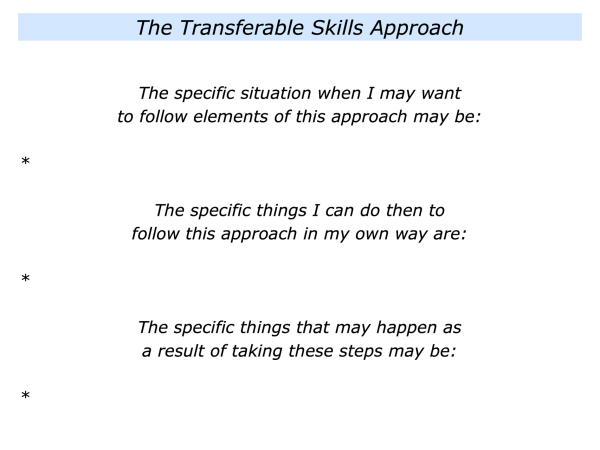
Let’s return to your own life and work. Looking ahead, can you think of a situation where you may want to follow elements of this approach? How can you do this in your own way?
If you wish, try tackling the exercise on this theme. This invites you to complete the following sentences.

Leave a Reply