


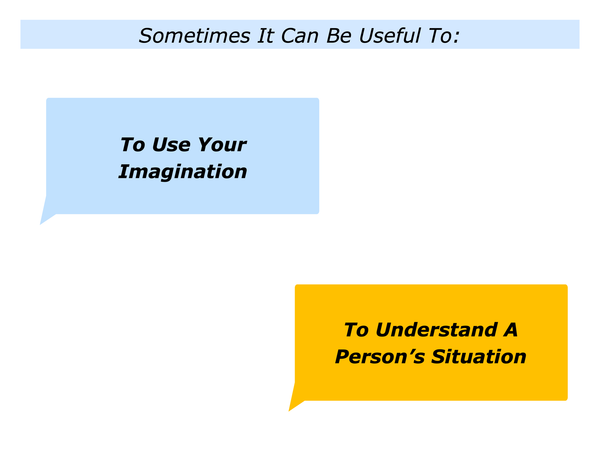
Many people talk about the importance of empathy. Another approach is to use your imagination to – as far as possible – understand a person’s situation.
This is an approach that requires both observation and insight when, for example, focusing on a person’s behaviour. Whilst you may or may not agree with what the person is doing, it calls for being able:
To understand a person’s situation – what is happening in their world – without necessarily agreeing with the ways they respond to the situation.
This approach calls for taking a helicopter view about what may be happening in their life and work. It also involves, to some extent, understanding the way they may see the world and make decisions.
As mentioned earlier, it does not necessarily mean that you agree with how the person behaves or feel they are justified in their actions. It is simply an approach to understanding their specific situation.
Imagine there may be times when you want to follow elements of this approach. This can involve focusing on the following themes.
You Can Use Your Imagination To
Understand A Person’s Situation
This involves recognising what may be happening in a person’s world. It does not necessarily mean trying to understand their deepest motives. Let’s look at one example.
Somebody may express their frustration about the way that another person behaves by saying:
“I don’t understand why they do that.”
This may be true. But it can also lead to exploring another couple of questions. Looking at the person who they may find frustrating, is it that:
a) They don’t understand why the person is doing certain things?
b) They don’t agree with what the person is doing?
It is often the latter. Bearing this in mind, it can be more helpful to clarify how they would like the other person to behave instead. It is then up to them whether they communicate this in the future.
Imagine that you are in a role where you may need to, as far as possible, understand a person’s situation. You may be acting as a therapist, coach, mediator, trusted advisor, consultant or in another role.
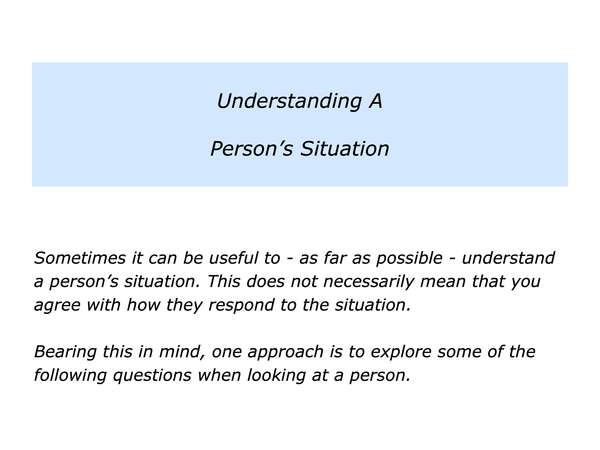
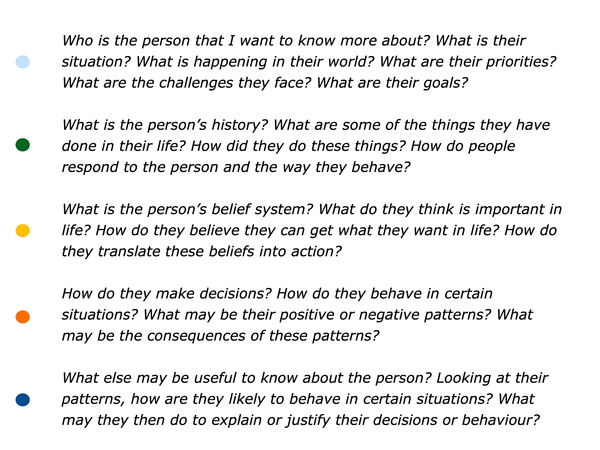
This often calls for gathering information in a non-judgmental way. How can you take this step? One approach is explore the following questions when considering a person. You will, of course, have your own approach to gathering such information.
You Can Decide What You Want To Do
After Understanding A Person’s Situation
Imagine that you have explored a person’s situation. You may have done this in your personal life when acting as a friend or relative. You may have done it when acting in a professional role.
The next step may be to decide what you want to do after recognising their situation. Much will depend, of course, on the circumstances and also how the person is behaving.
Bearing this in mind, you will have a number of options. You may simply want to store the information. Alternatively, you may want to act on it in some way. The second option raises some interesting points.
One of these was highlighted by a professional who was helping a person who said they wanted to move on from substance abuse. The professional explained their approach in the following way.
“Certainly it was useful to recognise what had happened – and what is happening – in the person’s world. But the key was for them to take responsibility for shaping their future.
“They could choose to take responsibility or use their back story as an excuse. The route they then took would have consequences – both for themselves and other people.”
As mentioned earlier, it can be helpful to understand a person’s situation because this can influence how they choose to behave. This does not mean, however, that you will necessarily agree with how they respond.
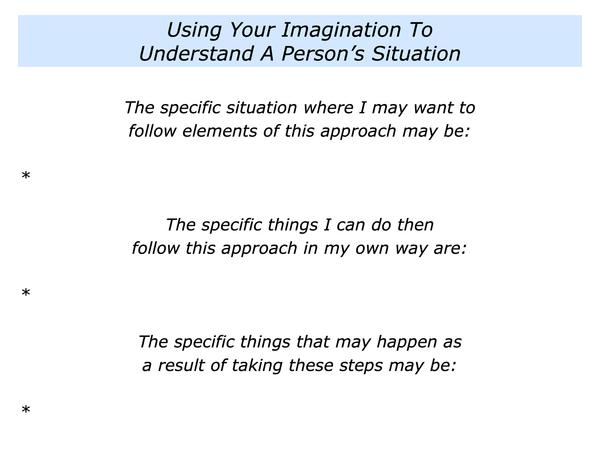
Let’s return to your own life and work. Can you think of a situation where you may want to follow elements of this approach? How can you do this in your own way?
If you wish, try tackling the exercise on this theme. This invites you to complete the following sentences.

Leave a Reply