


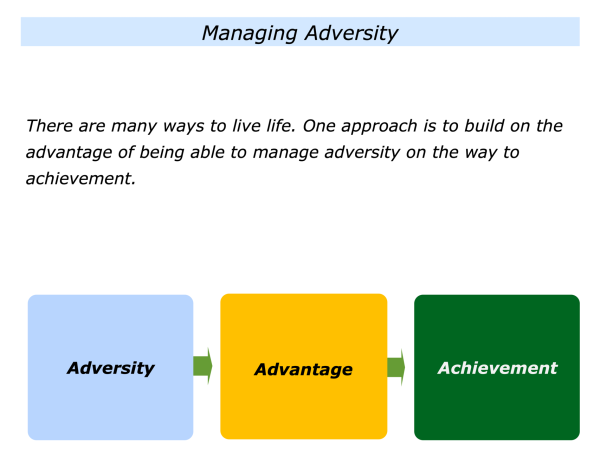
There are many ways to live life. One approach sounds counter-intuitive but it can actually help people. It involves learning how to build on the advantage of being able to manage adversity successfully.
This approach was described in the following way by a mentor to somebody they were mentoring. They advised the young person that it could be important for them to learn:
To build on their assets;
To build on the advantage of being able to manage adversity;
To build on these abilities to work towards achievement.
This approach mirrors elements of the answer sometimes given by a senior when asked about the potential of a talented person. They may say something along the following lines.
“Yes, the person is very talented, but I am not sure what they can achieve. So far they have been successful and, as far as I know, have not had any big setbacks.
“I will be able to tell you more about their potential after I have seen how they handle such challenges. Do they go into their shell or do they use the setback as a springboard for achieving future success?”
Some people develop by learning how to build on their assets and manage adversity. This can increase their ability to achieve their aims. Let’s explore how they may follow these steps.
Some People Build On Their Assets
One approach is to for a person to simply start by listing their personal and professional assets. Let’s look at one example.
Several ago I had a session with Dave. He had become depressed in his job and fallen into a negative spiral.
Bearing this in mind, I invited him to do the exercise called My Personal And Professional Assets. This invited him to clarify and build on these assets.
Within 30 minutes Dave had turned himself around. He aimed to tackle the challenges at work but also appreciate his true wealth. He explained this in the following way.
“I have good health, a fantastic wife and two lovely children. We have good friends, a home, a garden and a bit of money in the bank.
“I also have a lot of drive, energy and skills that can help companies to improve. I need to get out and give to people in my network, because this could lead to other opportunities.
“I must tackle the issue at work but it is solvable, even if it means moving to a new job. Sometimes I have the occasional sulk, but I can limit that to ten minutes. I can then get my act together and try to succeed.
“Today it has been good to take stock of my assets. Maybe it would also be good for me to sit down with my wife and do a similar exercise. We can build on what we have and plan our next move forward.”
What are your personal assets? You may have a positive attitude, a strong drive and good imagination. You may have reasonable health, a caring family and encouraging friends. You may be resilient, focused and able to find creative solutions to challenges.
What are your professional assets? You may have particular strengths and the ability to do strategic thinking. You may be good at helping certain kinds of people to succeed. You may also have a wide professional network of people, customers and potential employers.
If you wish, try tackling the exercise on this theme. This invites you to describe your personal and professional assets.
Some People Build On The Advantage
Of Being Able to Manage Adversity
Everybody has both successes and setbacks. Some people build on the successes. They also use the setbacks as a springboard to achieving future success. Some people deal with the adversity in the following way.
They take time to reflect, recover and manage the emotions involved with the setback;
They begin to see the setback as an opportunity to take stock and consider their potential future strategies;
They then use the setback as a springboard towards achieving future success.
A young football player may be discarded by their club or suffer a career-ending injury. They may reframe this as an opportunity to become a coach or provide advisory services for young players who find their dreams have been dashed.
A person with a harmful addiction may have a traumatic experience. This leads them to making a decision: “Do I want to live longer? Or do I or want to continue with my addictions and die soon?” They may choose to see this an opportunity to live a healthier life.
A couple may try for years to have a child. This becomes emotionally draining and challenging. After a number of years, however, they decide to reframe it as an opportunity to adopt children and provide them with a loving home and family.
A person in the 60s may find their job terminated with little hope of another full-time role. They may reframe this is as an opportunity to provide specialist help to decision makers in their network who want experienced people to do certain projects.
Looking back, can you think of a situation when you managed an adversity successfully? This could have been in your personal or professional life.
What did you do then to reflect, recover and explore the future opportunities? What did you do to pursue your chosen path? How did you do your best to achieve future success?
If you wish, try tackling the exercise on this theme. This invites you to complete the following sentences.
Some People Build On Their Assets
And Also Manage Adversity
On The Way To Achievement
Different people follow this approach in different ways. Stefan Edberg, the former Wimbledon Tennis Champion, said that he saw setbacks as an opportunity. Here is a summary of what he said.
“I sometimes actually welcome setbacks in a match because I know that my opponent will also have setbacks at some point.
“Being a resilient person, this gives me the chance to show that I can overcome setbacks better than other people.”
Jill Bolte Taylor translated adversity into doing brilliant work that helps others. Here is the introduction to her well-known TED Talk.
Neuroanatomist Jill Bolte Taylor had an opportunity few brain scientists would wish for. One morning she realised she was having a massive stroke.
As it happened – as she felt her brain functions slip away one by one, speech, movement, understanding – she studied and remembered every moment.
She went on publish My Stroke of Insight. Here is an excerpt from her website that explains some themes she explores in the book.
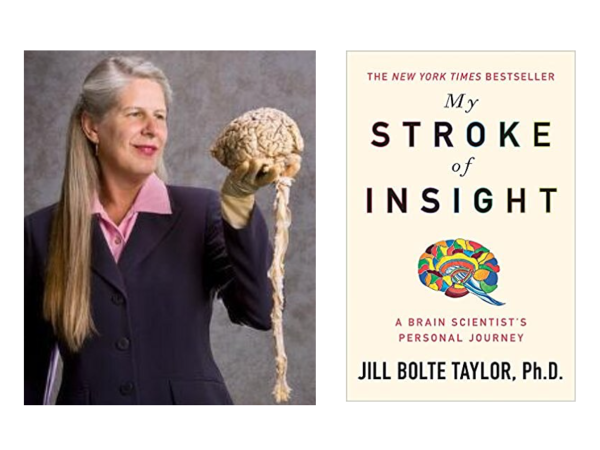
Jill shares with us her recommendations for recovery and the insight she gained into the unique functions of the right and left hemispheres of her brain. She helps others not only rebuild their brains from trauma, but helps those of us with normal brains better understand how we can ‘tend the garden of our minds’ to maximize our quality of life.
Jill teaches us through her own example how we might more readily exercise our right hemispheric circuitry with the intention of helping all human beings become more humane.
There are many ways to live life. One approach involves learning how to build on the advantage of being able to manage adversity successfully.
Let’s return to your own life and work. Can you think of a situation where you may want to follow elements of this approach? This could be in your personal or professional life.
What may be the situation where you may want to manage the potential adversity? How could you do this in your own way? How could you then move forward and, for example, work towards achieving your goals?
If you wish, try tackling the exercise on this theme. This invites you to complete the following sentences.

Leave a Reply