



Great teams encourage people to deliver consistently high standards. They make clear contracts with the teams and individuals about:
The specific standards they will deliver when
working towards achieving the picture of success
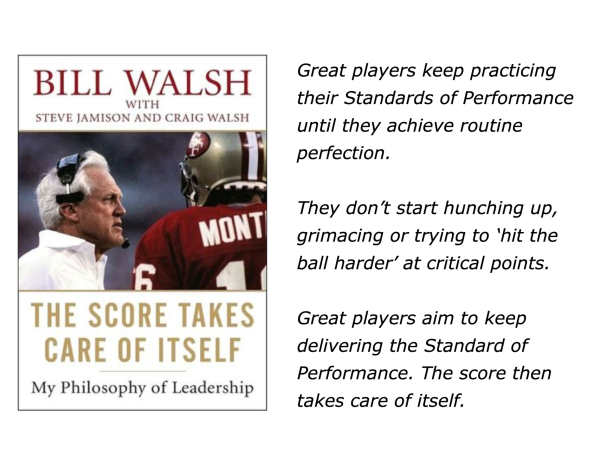
There are many models for encouraging people to maintain high standards. One can be found in the work of Bill Walsh, the coach of the San Francisco 49ers American Football team.
Bill believed it was vital for everybody in an organisation to deliver a certain Standard of Performance. This was more important than striving for winning. He believed that, providing people consistently delivered the Standard of Performance, the score took care of itself.
Did it work? Despite not focusing on winning, his team was hailed as a dynasty.
It took two seasons – 1979 and 1980 – to turnaround the ailing team. The 49ers then won the Super Bowl three times – in 1981, 1984 and 1988 – before Bill retired.
Taking Over The San Francisco 49ers
Bill took over the team in 1979. Interviewed for the book The Score Takes Care of Itself, by Steve Jamison and Craig Walsh, he said that his aim was to create an environment of excellence.
The first two years were difficult. He aimed to build a top-notch organisation rather than one that was toxic.
This called for hiring great people and moving on those who chose not to meet the required standards. Bill explained this in the following way.
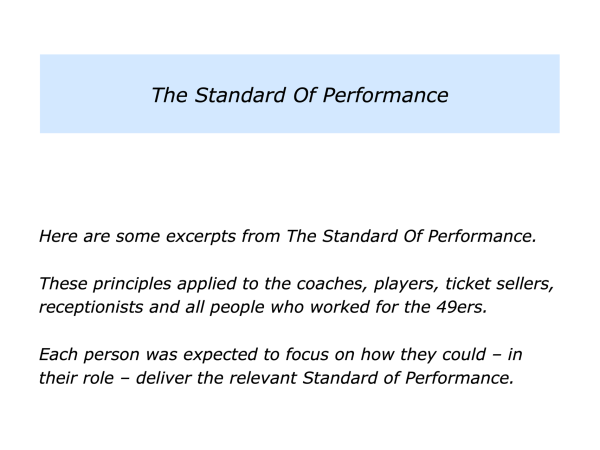
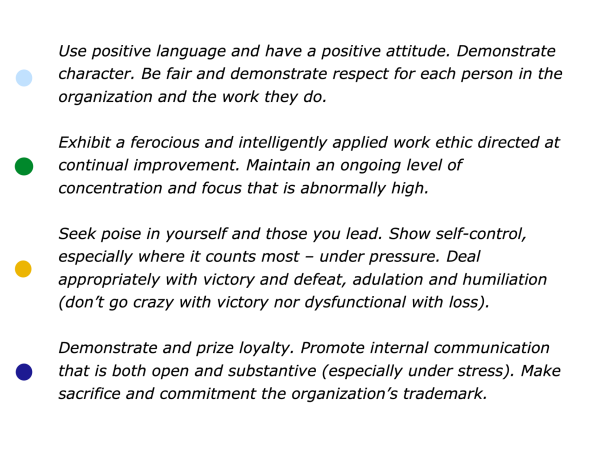
“I came to the San Francisco 49ers with an overriding priority and specific goal – to implement what I call the Standard of Performance.
“It was a way of doing things, a leadership philosophy that has as much to do with core values, principles, and ideals as with blocking, tackling, and passing: more to do with the mental than with the physical.
“While I prized preparation, planning, precision, and poise, I also knew that organizational ethics were crucial to ultimate ongoing success.
“It began with this fundamental leadership assertion: Regardless of your specific job, it is vital to our team that you do that job at the highest possible level in all its various aspects, both mental and physical (i.e., good talent with bad attitude equals bad talent).
“There are also the basic characteristics of attitude and action – the new organizational ethos – I tried to teach our team, to put into our DNA.
“Of course, for this to happen the person in charge – whether the head coach, CEO, manager, or assembly line foreman – must exhibit the principles.”
This called for commitment to details, such as people having a positive attitude, no shirttails out when wearing the 49ers uniform, being prompt, showing good sportsmanship.
No strutting, posturing or cheap shots, controlling of profanity, treating fans with respect and always exhibiting professional behaviour.
Bill believed that leaders must develop the right strategy for delivering success. This included developing the right planning for tackling various scenarios. He explained this in the following way.
“The motto of the Boy Scouts, ‘Be prepared,’ became my modus operandi, and to be prepared I had to factor in every contingency: good weather, bad weather, and everything in between.
“I kept asking and answering this question: ‘What do I do if…?’
You must envision the future deeply and in detail – creatively – so that the unforeseeable becomes foreseeable. Then you write the script for the foreseeable.
“Of course, there’s always something you can’t anticipate, but you strive to greatly reduce the number of those foreseeables.”
He followed the 80/20 rule. The 49ers focused on maximising the 80% they could control in a game. There may be 20% they couldn’t control, such as a referee’s call, a bad bounce or fortune.
Bill encouraged his teams to prepare properly. People were expected to practice relentlessly until their execution at the highest level was automatic. He called this routine perfection and described it in the following way.
“Maintenance workers, ticket takers, parking lot attendants, and anyone receiving a pay check with the emblem of the San Francisco 49ers on it were instructed as to the requirements of their own job’s Standard of Performance and expected to measure up.”
Bill saw himself as a teacher as well as a coach. He believed in encouraging and enabling motivated people to consistently deliver the basics. They could then add the brilliance.
Looking back at his time at the 49ers, Bill said the turnaround took time. Some people chose not to meet these standards, so they were moved on. Despite setbacks, people began to deliver the required standards. He explained this in the following way.
“Eventually – within months, in fact – a high level of professionalism began to emerge within our entire organization.
“I moved forward methodically with a deep belief that the many elements of my Standard of Performance would produce that kind of mindset, an organizational culture that would subsequently be the foundation for winning games.
“The culture precedes positive results. It doesn’t get tacked on as an afterthought on the way to the victory stand. Champions behave like champions before they’re champions; they have a winning standard of performance before they are winners.”
Bill was true to his philosophy and principles. The key was to ensure that people delivered the Standard of Performance. Then, as a by-product, they often got positive results.
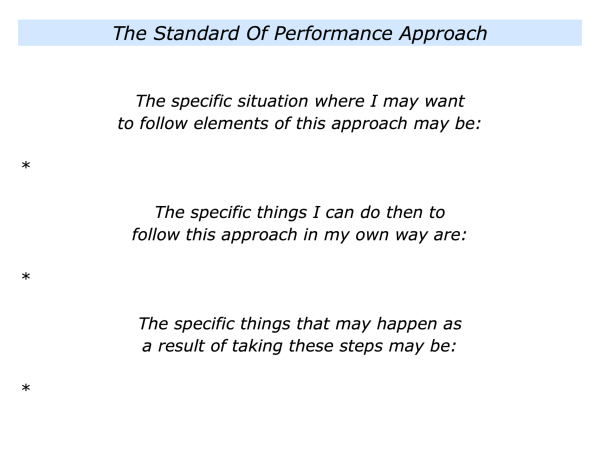
Let’s return to your own life and work. Looking ahead, can you think of a situation where you may want to follow elements of the standard of performance approach? How can you do this in your own way?
If you wish, try tackling the exercise on this theme. This invites you to complete the following sentences.

Leave a Reply