



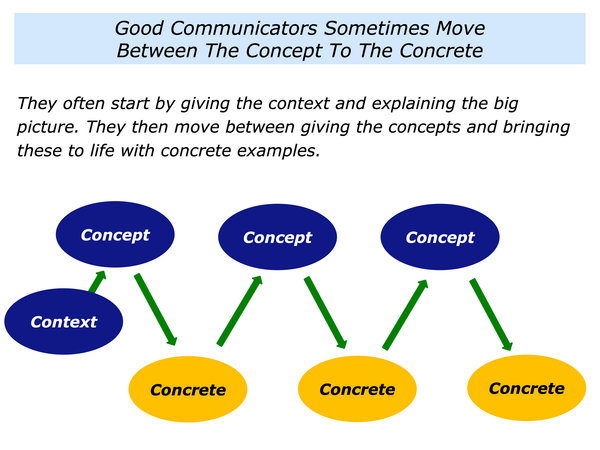
Good communicators move between the concepts to the concrete and aim to give examples that resonate with people. Some do this by working through the following themes.
Context
They start by giving the context – the bigger picture. This can give people the background and the reasons for working to achieve certain goals.
Concept
They may then introduce a concept. This may be a strategy, for example. that people can follow to work towards achieving their goals.
Concrete
They move between the concept and the concrete. They give concrete examples that can help people to work towards achieving the goals.
Different people move from the concept to the concrete in different ways. Some follow each of the ideas they introduce by saying:
“For example …
This forces them to bring the idea to life and give an example that rolls off the tongue. They then aim to communicate this in a way that resonates with people.
Imagine you are a leader, educator or keynote speaker. Let’s explore how you may follow elements of this approach in your own way.
You Can Start By
Setting The Context
Great communicators start by giving the context and helping people to see the big picture. Depending on the situation, different people will do this in different ways. Here are some examples.
The Leader May Say:
We as a team are aiming to achieve the following picture of success … The positive benefits of achieving these goals will be …
So far are doing the following things well that will help us to achieve the goals … We will be looking at how to build on these things.
There are also some areas we can continue to improve. We will be looking at practical way we can improve in these areas.
Bearing these things in mind, today we are going to explore the following themes that will help us to achieve the picture of success.
The Educator May Say:
As you know, we are studying the field of … So far we have covered the following themes …
Today we are going to focus on the following theme … The way this fits into the big picture of what we are studying is …
Bearing this in mind, here is an introduction to this theme …
Good communicators recognise that people like to see the context and frame of reference. People are then more able to slot the information into the big picture.
Imagine that you are communicating with a person or a group people and have given them the context. When appropriate, it may then be time to move on to the next stage.
You Can Give
The First Concept
Good communicators introduce the first concept. This can be the first theme, strategy or the idea they want to cover. Again, much will depend on the specific situation.
Imagine that a leader wants to encourage their managers to act as good models for people in the business. They may introduce the concept in the following way.
Good leaders recognise that they are always ‘On Stage’. People learn from what the leaders do, not what we say.
Parents act as models for their children. We are obviously not parents to our staff, but people will watch us to see how we behave.
Some of the keys are to be positive and predictable. This can provide a platform for encouraging motivated people to achieve peak performance.
Bearing this in mind, it can be good if we try to act as positive models.
Perhaps this sounds too demanding, because we are human beings and will make mistakes. People will pick up on our mood, however. They will also watch the way we communicate, speak and act.
Looking back on your own life, remember how you reacted to teachers and managers. You probably watched them closely to read their emotions. You may then have judged what it was safe to say or do.
Positive modelling is crucial because the way we behave can have a profound effect on the business. So in a moment I will give some examples of how we can continue to try to be positive models.
Imagine that you are following elements of this communication approach in a specific situation. Let’s assume that you have introduced the first concept you want to share with people. It can then be time for the next stage.
You Can Move
To The Concrete
Good communicators move from the concept to the concrete. How to make this happen? One approach is simply to follow each of the ideas you introduce by saying:
For example …
This immediately forces you to give a specific example that brings the idea to life. Providing you are clear on the idea – and know your onions – you will find that the examples come easily.
Good communicators give examples that resonate with people and show how to translate the concept into action. Different people will do this in different ways. Let’s look at one situation.
Imagine that a leader is describing the importance of people being positive models and recognising that they are always ‘On Stage’. They may bring this to life by giving examples about how it is possible to behave when:
Arriving at work in the morning … Greeting the receptionist … Meeting people in the lift … Walking into the main office … Aiming to create a positive atmosphere.
Encouraging people to focus on the organisation’s purpose … Following the principles … Preparing properly for meetings … Making clear working contracts … Helping people to achieve success.
Let’s assume that you have brought the first concept to life by giving concrete examples. You can then focus on the next concept and repeat the process. When appropriate, you can move on to the next stage.
You Can
Conclude The Session
Good communicators move between the concept and the concrete until they have covered all the topics. When appropriate, they may conclude the session by doing the following things.
They describe again the key messages – the concepts and concrete examples – that they want people to remember.
They describe the specific action plan for translating these into action and getting some early successes.
They describe the specific things that will be done to support people and help them to translate the ideas into action and deliver success.
Let’s return to your own life and work. Looking ahead, can you think of a situation where you may want to follow elements of this approach? How can you do this in your own way?
What may be the specific situation? How can you start by giving people the big picture and context? How can you move between the concepts and concrete? How can you then conclude the session?
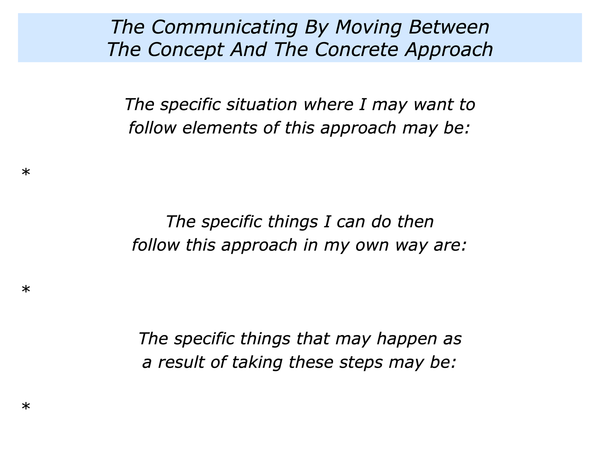
If you wish, try tackling the exercise on this theme. This invites you to complete the following sentences.

Leave a Reply