



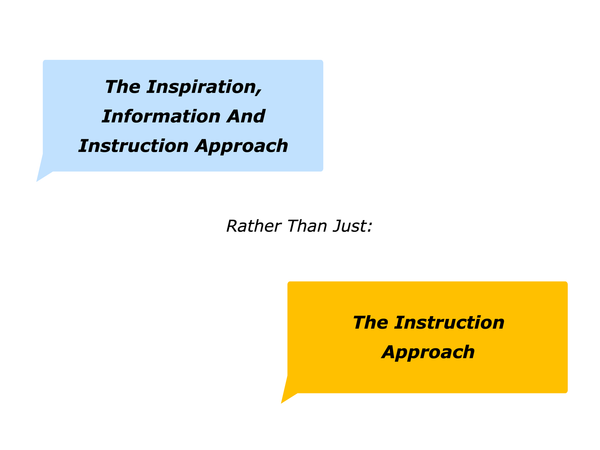
There are many ways to help people to learn or work towards a specific goal. One model is to follow the information, information and instruction approach. This can be more effective than just giving instructions.
Imagine that you want to follow elements of this approach when inviting people to work towards achieving specific goals. Let’s explore this theme.
The Inspiration, Information
And Instruction Approach
Good educators create an inspiring environment in which motived people can work towards certain goals. This may not always be possible in your situation, but it can sometimes be useful to present things in a positive way.
One approach is to make sure that people can see the big picture and the context. They may then feel more motivated to do something rather than just being urged to follow instructions.
You may wish to start by explaining the specific goals to achieve and the benefits of achieving these aims. Bearing this in mind, you can describe the following things.
The What: The specific goals
we aim to achieve are:
*
*
*
The Why: The specific benefits
of achieving these goals will be:
*
*
*
Imagine that you have done your best to create a positive environment and give people the big picture. The next stage can be to give people more information.
Much depends, of course, on the information you want to give. One approach is to again explain the What and the Why – especially the positive benefits of achieving the goals.
You can then explain the guidelines – such as the strategies – to follow to reach the goals. You can also describe what needs to be delivered and by when. Bearing this in mind, you may explain the following things.
The How: The specific guidelines to follow
when working towards achieve these goals are:
*
*
*
The When: The specific things that need to be delivered
by when on the way towards achieving the goals are:
*
*
*
Let’s assume you have explained the What, Why, How and When. The next step will be to focus on Who will be doing what on the way towards delivering the goals.
Different leaders do this in different ways. One approach is to take the following steps. They sound risky but they are most likely to increase the chances of success. this approach involves giving people chance to reflect and then:
To clarify who is prepared to do what on the way towards achieving the goals;
To clarify each person’s responsibilities and make clear contracts about their contributions towards achieving the goals;
To clarify they guidelines to follow – including any key instructions – and then for people to work towards achieving the goals.
The instructions part can be interesting. This involves making sure that each person understands the guidelines to follow and the specific actions required to achieve the goals.
Some people will be able to follow these guidelines – and get the details right – because they have certain skills and high quality standards. Some may have hesitancy or difficulty in delivering the required standards.
One approach is to meet with such a person – especially if they are a linear thinker – and take the following steps. It is to describe the following things.
“This is the What – The goals we want to achieve. These are the benefits of achieving the goals. Are these something you are prepared to work towards achieving? If so, we can then move on to the next step.
“This is the How – The guidelines to follow to achieve the goals. Are you prepared to follow these guidelines? If so, do you know how to follow them? If not, would you like to learn how to follow them?”
Motivation is vital. A person needs to have the will before they can develop a skill. Bearing this in mind, it is important to make sure a person is prepared to do what is required to achieve the goals.
Sometimes a person will then be able to follow the guidelines and translate them into action. Sometimes you may need to show them what to do and how to do it. You can then help them to develop and achieve the goal.
This approach may seem a long process, but the upfront work pays off in the long run. It involves making sure you are working with motivated people. They are then more likely to become self-managing and do good work on the way towards achieving the goals.
You can then have follow up meetings with each person where they report their progress. You can start by refocusing on the goals to achieve. The person can then report on:
The specific things that are going well – and how they can build on these – on the way towards achieving the goals;
The specific things that can be improved – and how – on the way towards achieving the goals;
The specific steps they are now going to take – and any support required – on the way towards achieving the goals.
This is one approach to going through the stages of inspiration, information and instruction. As mentioned earlier, this can take some time upfront, but can pay off in the long run.
Some leaders just issue instructions. Sometimes this is necessary and works. But sometimes it can lead to people simply putting their heads down, not thinking for themselves and becoming institutionalised.
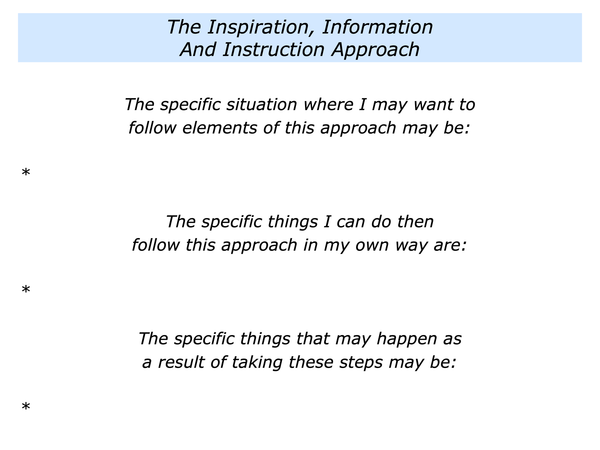
Can you think of a situation where you may want to follow elements of the inspiration, information and instruction approach? How can you do this in your own way? Here is an exercise on this theme.

Leave a Reply