


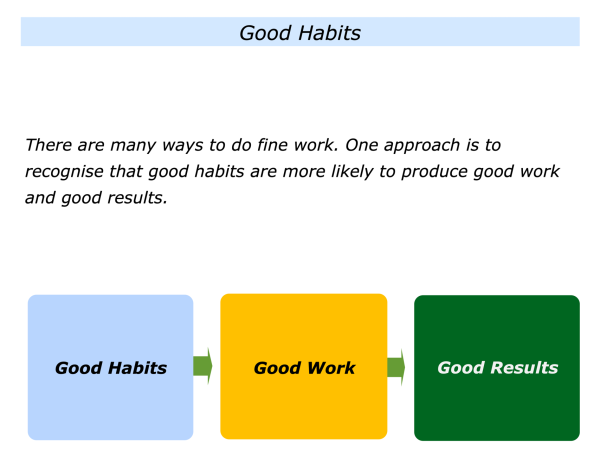
There are many ways to do fine work. One approach is to recognise that good habits are more likely to produce good work and good results. Different people follow this approach in different ways.
A recovering alcoholic may aim to follow good habits one day as a time on the way to staying sober and working towards their life goals.
An athlete may aim to follow good habits so they can focus and block out any noise on the way to performing at their best.
A team may aim to follow good habits when continuing to do the basics and then, when appropriate, adding the brilliance.
People who take such steps aim to follow routines that work. At the same time, however, they retain their ability to be agile and deal with random events. Let’s explore how people may translate this approach into action.
Good Habits
Aristotle is often quoted as saying that excellence is a habit. But it was actually Will Durant who, writing in his 1926 book The Story of Philosophy, summarised this part of Aristotle’s philosophy. He wrote:
We are what we repeatedly do. Excellence, then, is not an act, but a habit.
Looking at your own life, can you think of an activity where you want to follow good habits? You may want to do this to maintain your health, encourage other people or continue to develop.
Different people follow this approach in different areas of their lives. The following sections explore how they may follow good habits.
Being Positive
Some people aim to continue to be positive. Such people often follow the philosophy that what you focus on you become. Bearing this in mind, they may aim to follow certain good habits. They may aim:
To focus on the positive things in their lives … To count their blessings rather than their burdens … To keep a gratitude journal … To be kind and encourage other people … To spend time with positive people.
To focus on the principles they want to follow in their life … To aim to translate these into action … To find solutions to challenges … To look back and be thankful for some of the things they have done that day.
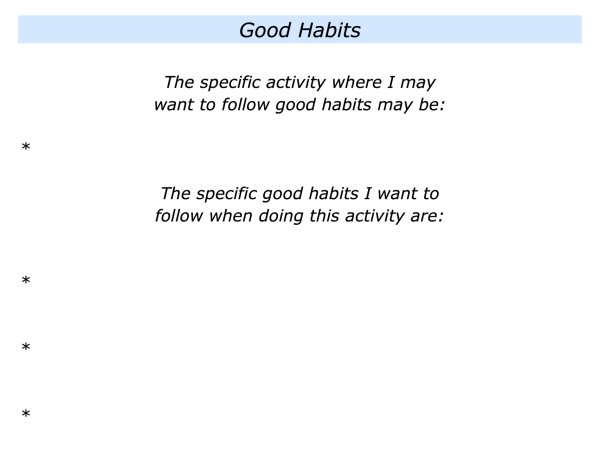
Let’s return to your own life. Can you think of a specific activity where you may want to follow good habits? What may be the activity and the habits you want to follow? What may be the benefits of taking these steps?
If you wish, try tackling the exercise on this theme. This invites you to complete the following sentences.
Good Work
Great workers often follow certain habits. These provide the platform for doing good work and delivering peak performances. Twyla Tharp, the dancer, choreographer and author, described elements of this approach in the following way.
Being Creative
Being creative is an everyday thing, a job with its own routines. The routine is as much part of the creative process as the lightning bolt of inspiration (perhaps more).
And it is available to everyone. If creativity is a habit, then the best creativity is a result of good habits.
This was a pattern that I found time after time when studying peak performers. Such people followed good habits in their work. Some of them aimed:
To follow their chosen rhythm each day … To make good use of their prime times – the times when they had most energy … To organise their time in blocks so they could concentrate fully and cut out any noise.
To rehearse what they were going to do … To set specific achievable goals … To follow their ritual for moving into action … To perform superb work … To embody continuous improvement when working towards their goals.
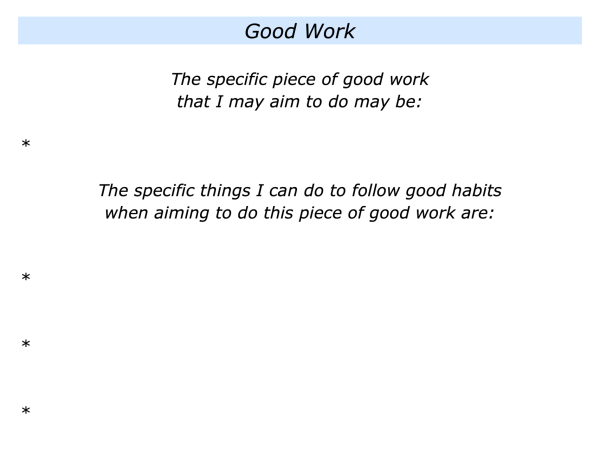
Let’s return to your own situation. Can you think of a specific piece of good work that you may want to do? What are the good habits you can follow when aiming to this piece of good work?
If you wish, try tackling the exercise on this theme. This invites you to complete the following sentences.
Good Results
Looking ahead, can you think of a situation where you would like to achieve good results? Much depends, of course, on the following things in your life or work:
The specific things you can control in the situation;
The specific results you want to achieve;
The specific things you can do to do your best to achieve the desired results.
Different people may also have different aims in life. Some people want to achieve money, status or other pictures of success. Some people want to tod their best in life and experience a sense of peace. One approach is to focus on the following principle.
Being The Best You Can Be
Imagine that you want to follow elements of the being the best you can be approach. Much depends, of course, on what you believe is important in life. This will strongly influence the results you want to achieve.
Bearing this in mind, however, you may aim to follow good habits to do some of the following things.
To build a happy family … To pass on skills that students can use to shape a positive future … To help people to do satisfying work … To help people to work towards achieving their life goals.
To help people to recover from setbacks … To create experiences that give people positive memories for life … To do pioneering work in medicine, science or another field.
To do your best in life … To achieve specific goals in your work, sport or business … To pass on knowledge that people can use to achieve success … To sometimes experience a sense of peace.
Let’s return to how you can build on what you believe is important in life. Can you think of a situation where you may want to achieve good results? This could be in your personal or professional life.
Bearing in mind what you can control in the situation, what are the results you want to achieve? What are the good habits you can follow to increase the chances of getting those results?
Looking ahead, how you follow those good habits? How can you then do your best to achieve the desired results in the situation? What may be the benefits of taking these steps?
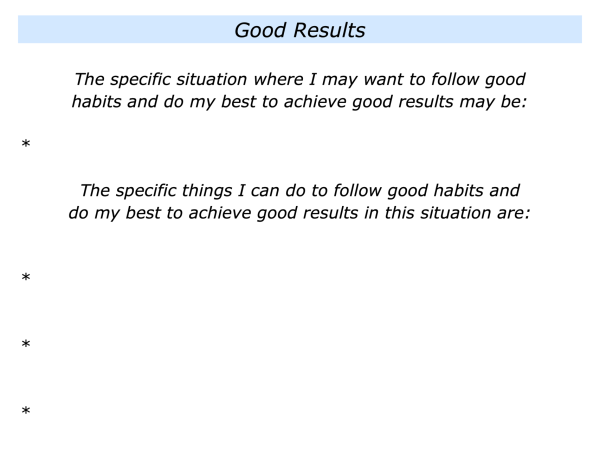
If you wish, try tackling the final exercise on the theme of following good habits. This invites you to complete the following sentences.

Leave a Reply