



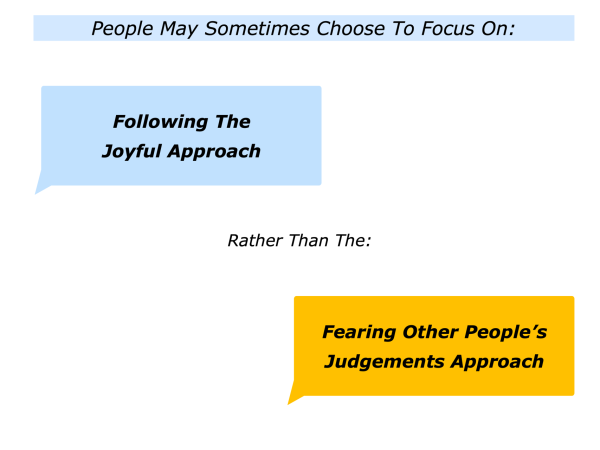
Different people choose to follow different approaches to life. The route they follow can have consequences for both themselves and other people.
Some people follow the joyful approach. They aim to do things that bring joy to themselves or other people. They are open to ideas to improve but may grow beyond fearing other people’s judgements.
Some people follow the judgemental approach. They are quick to judge what other people do in their lives and work. Some other people may be judgemental towards themselves in ways that hurt rather than help them.
Some people follow the joyful approach but are also good judges of situations. They focus on how to help themselves and others to thrive in their lives and work.
Different people follow these approaches in different ways. Let’s explore these themes.
The Joyful Approach
People love to experience a sense of joy. They often find this comes as an outcome of doing certain things, however, rather than making joy an end in itself. Different people achieve this feeling in different ways.
Looking at your own life, what are the things you do that may lead to feeling joyful? Here are some answers that people have given to this question.
The specific things I do that
may lead to a sense of joy are:
Giving to other people … Counting my blessings … Listening to music … Singing in a choir … Nurturing my garden … Cooking for other people … Being with our children … Caring for animals.
Doing stimulating projects at work … Making wood sculptures … Coaching athletes … Being a trusted advisor to my clients … Helping people to solve problems … Giving myself time to appreciate life.
Many people enjoy helping others to experience joy. They may do this as a parent, partner, friend, educator, chef, artist, performer, medic or in another role.
Some people rediscover the ability to follow the joyful approach at a certain point in their lives. The following section describes one example from a footballer. But it is approach mirrored by many athletes in their careers.
Luke O’Nien is a professional footballer who played for Sunderland in the Premier League. Speaking on the High Performance podcast, he describes how much of his career was hindered by fear.
He loved playing football as a child and dreamed of playing as a professional.
Demonstrating talent, he was spotted by scouts and began climbing through the different age levels.
He continued to enjoy training but began to fear the judgement of others who could jettison him from the system.
Luke threw himself into working hard but began to worry more about making mistakes.
He progressed through the age groups and became a professional but found that the joy had gone from his game.
He saw that many other players became scared and worried about the judgement from coaches, spectators and social media.
He found that the psychological pressure led to his peripheral vision narrowing which affected his game and led to making mistakes.

Luke managed to carry on and, after many struggles, managed to play in the Premier League.
There came a point, however, when he sought help from Rob Blackburne, a sports psychologist and also a therapist.
He then made breakthroughs and, seeing how sport is just one part of his life, has since rediscovered the joy of playing.
Luke has learned a lot from his journey and now helps others who want to follow the route of joy rather than fearing the judgement of others.
People who follow the joyful approach are open to ideas that can help them to improve. But they realise that some people will never approve of what they do. This highlights another approach.
The Judgemental Approach
Many people have strong views on how to live life. Some express these in a judgemental way. They believe their approach is the only way to live and are intolerant of people who are different.
Such people sometimes see themselves as superior to others. They may criticise, attack or aim to suppress those who think or behave differently. Some get a kick out of trying to make others feel small or afraid.
Some people have a different approach to being judgemental. They are judgemental towards themselves. Maybe because of their upbringing, they may have negative scripts.
Such people keep criticising themselves or feel that whatever they do will never be good enough. They may link their own self-esteem to how other people judge them.
They may seek constant affirmation or aim to get accolades. Such responses may work for a while. But they then embark on another round of aiming to be judged as worthwhile in other people’s eyes.
The Being A Good Judge In
Certain Situations Approach
Some people follow the joyful approach but are also good judges in certain situations. They are often savvy. They have lots of life experience and take the following steps:
They continue to do things that help themselves and other people to experience joy;
They have the ability to read situations, recognise patterns and see the potential consequences;
They are good at making decisions that will enable themselves and other people to thrive.
Such people are good at reading reality. They may also have built a repertoire of tools they can apply in both personal and professional situations. They then aim to apply this knowledge to get the desired positive results.
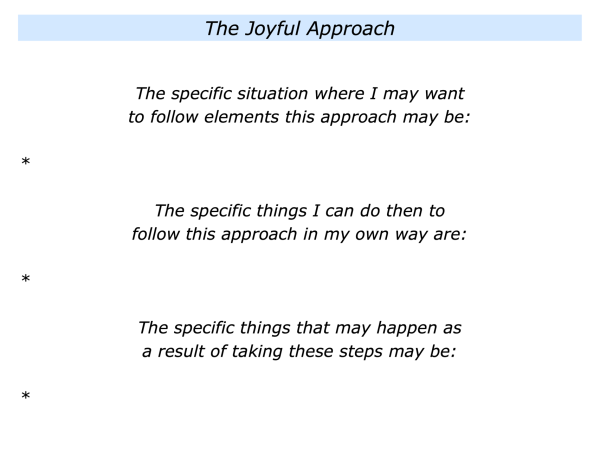
Let’s return to your own life and work. Looking ahead, can you think of a specific situation where you may want to follow elements of the joyful approach? How can you do this in your own way?
If you wish, try tackling the exercise on this theme. This invites you to complete the following sentences.

Leave a Reply