


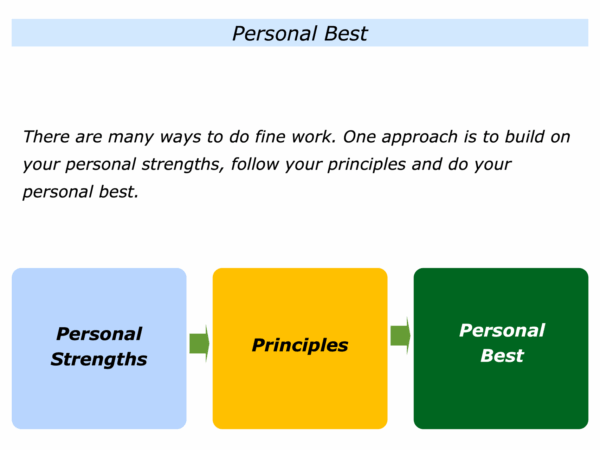
There are many ways to do fine work. One approach is to build on your personal strengths, follow your principles and do your personal best. Let’s explore how it may be possible to follow these steps.
You Can Build On
Your Personal Strengths
This step involves focusing doing what you do best. It involves building on your strengths, following your successful style and aiming to achieve your picture of success.
There are many ways to take this step. Here are some of the most common approaches that people take to do what they do best in their lives and work.
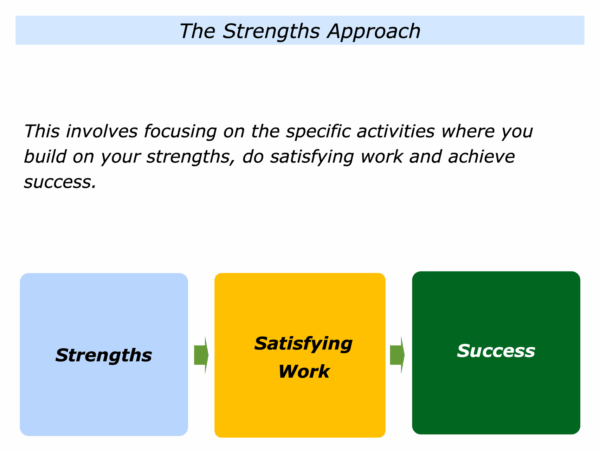
This is a well-known approach. It is to focus on the specific activities where you can build on your strengths, do satisfying work and achieve success.
How to find your strengths? One approach is to explore some of the classic questions. These include focusing on the following themes.
What are the specific activities where I can deliver As rather than Bs or Cs? When am I in my element – at ease and yet able to excel? What are the things that I feel passionately about where I may have the ability to deliver peak performances?
The next step is to focus on doing one of these activities. You can then aim to set specific goals, perform superb work and do your best to achieve your picture of success.
The Sparks Approach
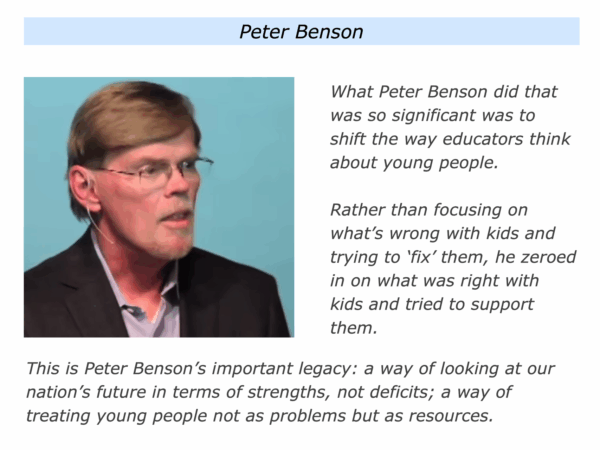
Peter Benson was a pioneer of this approach. Much of his work focused on helping children and teenagers but the principles he outlined can be applied to people of all ages. He and his colleagues at the Search Institute focused on the times when young people came alive. Peter described these in the following way.
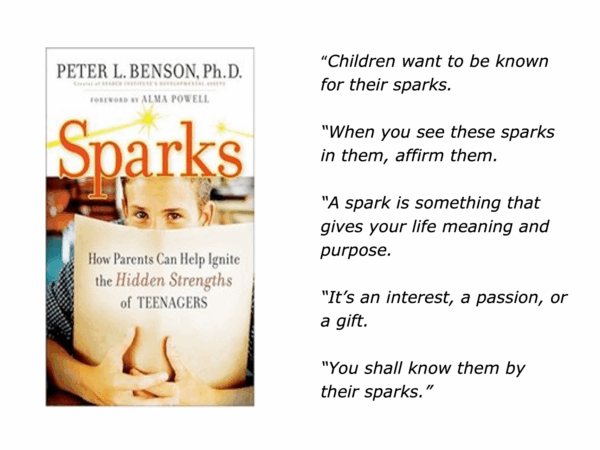
Peter looked for the good in everybody and everything. Whilst being a rigorous researcher, he conveyed his findings about people in a compassionate and inspiring way.
Joining the Search Institute in 1985, he played a key part in pioneering Positive Youth Development programmes across the world. Here is an extract from the Institute’s web site.
Sparks are the hidden flames in kids that excite them and tap into their true passions. Sparks come from the gut. They motivate and inspire. They’re authentic passions, talents, assets, skills, and dreams.
Sparks can be musical, athletic, intellectual, academic, or relational; from playing the violin to working with kids or senior citizens. Sparks can ignite a lifelong vocation or career, or balance other activities to create an emotionally satisfying, enriched life.
Sparks get kids going on a positive path, away from the conflicts and negative issues – violence, promiscuity, drugs, and alcohol – that give teens a bad name and attract so much negative energy.
Peter defined thriving as feeling fully alive, happy and giving to others. He described in the article Thriving Starts On The Inside.
The idea of spark is very much like the idea of spirit. The word spirit comes from Latin and means ‘my breath, put into the world with vigour and courage.’ Your breath, your essence, your spark.
Most of us, however, discover our spark between the ages of 10 and 20. You know it when you feel it. That is, you know it when you are doing something that makes you feel whole, when time stands still, when just doing it or being it is its own reward.
Being great at it or impressing people with it is not the point. Just knowing it, affirming it and putting it into play is the point. Youth, when talking about their spark, almost always use romantic language in describing it.
They say things like, “I love it when I’m playing the piano,” or “I cherish the moments each day when I can help someone.”
Thriving starts on the inside, with the knowledge and affirmation of your spark and the courage to put it into play. That’s how we fall in love with life. The spark is a seed waiting to find fertile soil and a chance to flower. Name it. Love it. Use it to light up our world.
Peter died at the age of 65 in 2011. The Search Institute described him in the following way. “An inspiring leader who devoted his own life to making the world a better place for families, schools and communities.”
Neal Starkman also provided a view of Peter’s work. Writing on his blog, he paid the following tribute.
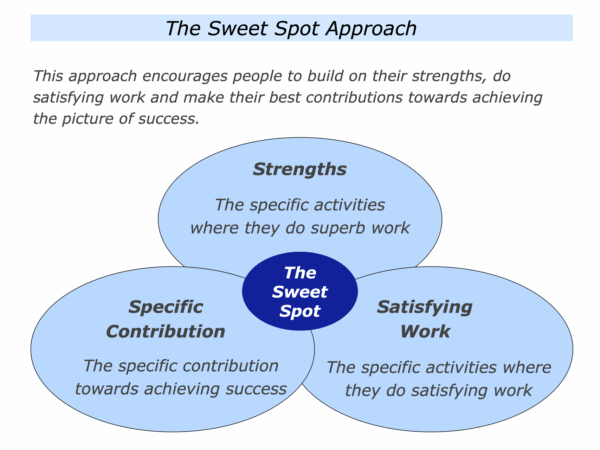
This is an approach that can be used by individuals, teams and organisations. It encourages people to build on their strengths, do satisfying work and make their best contributions towards achieving the picture of success.
The sweet spot concept stems from sport. Since then it has been applied to many other areas of life. Here are some definitions.
The point or area on a bat, club, or racket where it makes most effective contact with the ball.
The particular situation or combination of things that is the best and most effective possible.
The spot where you do something that may appear effortless but sometimes produces the most effective results.
Some elements of this approach have been used in career development workshops since the 1960s. It encourages individuals to do what they do best and make their best contributions to a team or organisation.
The approach is obviously related to the Japanese concept of Ikigai. But it does not necessarily cover their purpose, vocation or mission on the planet. When appropriate, however, these are themes I sometimes explore with a person. This involves focusing on the following themes.
Strengths. The specific activities where they do superb work.
Satisfying Work. The specific activities where they do satisfying work.
Specific Contribution. The specific contribution they can make towards helping people, the team or the organisation to achieve success.
Imagine that you have focused on a specific activity where you can play to your strengths. If appropriate, you may want to set specific goals and move into action.
There are many ways to take this step. One approach is to focus on following your principles. Let’s explore this theme.
You Can Follow
Your Principles
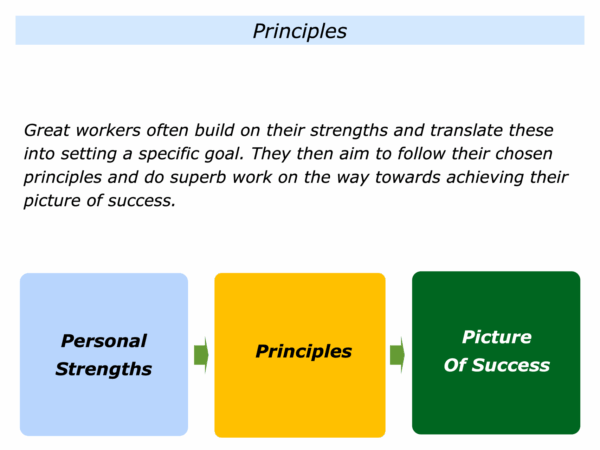
Great workers often build on their strengths and translate these into setting a specific goal. They then aim to follow their chosen principles and do superb work on the way towards achieving their picture of success.
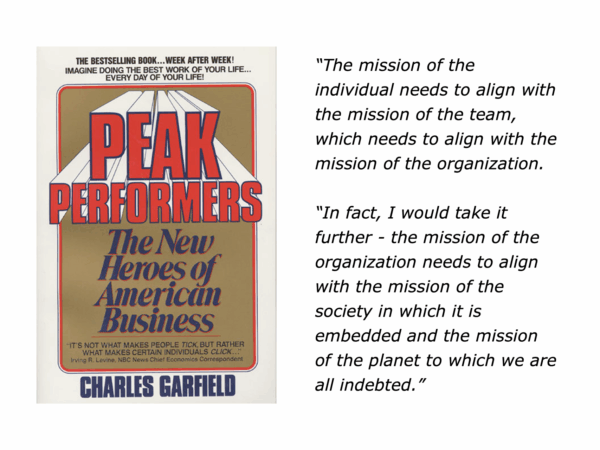
Such people then aim to do their best. Charles Garfield inspired people to follow this approach. Writing in his books Peak Performers and Second to None, he encouraged people to become the best they could be. He wrote:
“Do not compete with anyone except yourself.”
He said it is vital for people to work towards a compelling purpose. He saw this when working as a computer analyst and leading engineers, scientists and staff on the Apollo 11 project.
Charles also founded the Shanti Project. This is a volunteer organisation that focuses on delivering service excellence for patients and families facing life-threatening illness.
Alongside this he worked as a clinical professor at the University of California Medical School in San Francisco. Charles said he first heard the phrase peak performance from a cancer patient who said:
“Staying alive these days is my peak performance.”
He remembered the phrase and went on to study great workers in many fields. These included people in medicine, sports, business and the NASA work in which he was participating.
Charles said that towards the end of the 1970s he discovered a common trigger for peak performance. People were often motivated to follow certain principles.
They then translated this into pursuing a mission that gave them a sense of purpose. The key factor, said Charles, was for them to make an internal decision to perform at their best. He wrote:
Now I began to understand what I was hearing and seeing, as one peak performer after another spoke of self-training, learning by experience, organizing that experience around a single theme, speaking and finding a purpose, a personal mission that represents something important.
They want to feel proud of themselves, to achieve something, to leave a mark and a contribution, and they follow their plans for doing all that purposefully and tenaciously. That is what I – and many others I knew – wanted.
So peak performers are not merely exceptions. They represent a kind of person any of us can be – once we find the capacity in ourselves.”
Different people follow different principles. Here are some that people may mention when describing those they want to follow in their lives or work.
My Principles – The Principles I Want
To Follow In My Life Or Work Are:
To encourage other people … To create positive environments in which people can grow … To create beauty … To deliver high quality work … To pass on knowledge that helps people to succeed.
Different people follow their principles in different ways. Mary Robinson, the former President of Ireland, believes in following the principle of kindness.
Whether the person is poor or a President, she shows warmth and tries to make the person feel the centre of her world. Mary explained this approach in her book Everybody Matters. This is followed by the official description of the book.
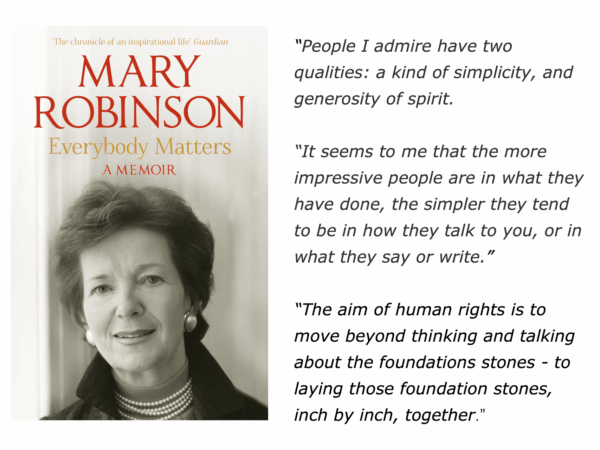
The first woman President of Ireland, who became UN High Commissioner for Human Rights, Mary Robinson has spent her life in pursuit of a fairer world.
She describes the upbringing which gave her a strong sense of values and how she came into painful conflict with her parents – marrying against their wishes and, later, helping to legalise contraception in a deeply Catholic Ireland.
As a barrister she won landmark cases advancing the causes of women and the marginalised against the prejudices of the day. When – to the surprise of many – she became the first woman President of Ireland in 1990, she put Ireland firmly on the international stage.
Accepting the position of UN High Commissioner for Human Rights in 1997 was her biggest challenge and here she describes the huge political difficulties she encountered among the many triumphs.
Subsequently, based in New York, she led Realizing Rights for eight years, pioneering how to implement in practice economic and social rights: working in African countries on health, decent work, corporate responsibility and women’s empowerment in peace and security.
Mary now heads her Climate Justice foundation and works on behalf of the millions of poor people most affected by climate change.
Told with the same calm conviction and modest pride that has guided her life, Everybody Matters will inspire everyone who reads it with the belief that each of us can, in our own way, help to change the world for the better.
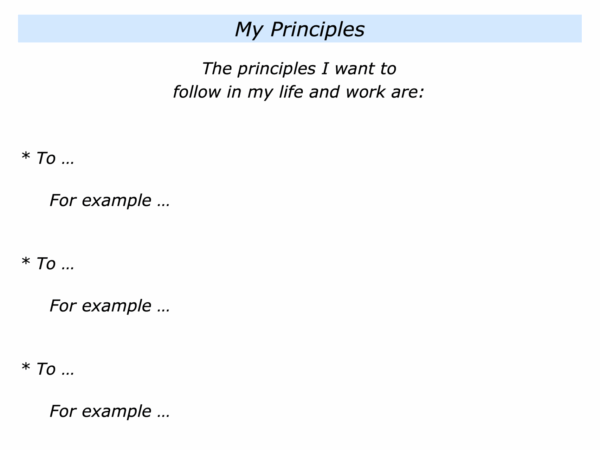
Let’s return to your own situation. What are the principles you want to follow in your own life or work? If you wish, try tackling the exercise on this theme. This invites you to complete the following sentences.
You Can Do
Your Personal Best
Great workers often aim to build on their person strengths, follow their principles and do their personal best. Different people do this in different ways. The following pages describe two people I have worked with who took this approach
Jacqui Smith – The
Birth Of Homesmiths
Jacqui uses her talents to create interior design for houses, care homes and retirement living. The following piece is one that Jacqui wrote many years ago. She and I met on a career development programme I ran for a travel company during the 1990s.
During our meetings we focused on her vocation. This was to create enriching environments. The following section describes how she moved from the marketing role she was doing to co-founding HomeSmiths with her husband David.
They started by doing work for friends and family on the weekends before going full-time. HomeSmiths has now been going for 20 years and moves from strength to strength.
Jacqui is now also a Regional Director for The Society of British & International Interior Design and Chair of the Haywards Heath Dementia Action Alliance.
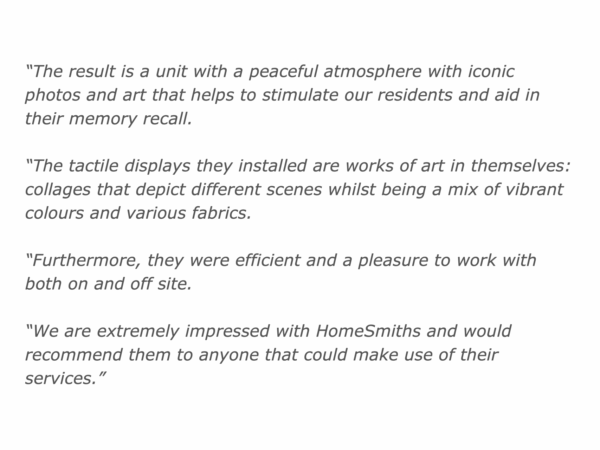
Below is a recommendation from one of Homesmiths’ clients. It describes how they helped with the design of a Dementia Unit.

The Birth of ‘HomeSmiths’
As a child I could spend hours creating room sets for my dolls, fiddling with doll’s house furniture, making camps for my brother to play in or rearranging my bedroom.
Whilst I followed art and excelled at it through my childhood and teens, my school was fiercely academic. So when it came to ‘A’ Level choices, Art was dropped in favour of Economics, Maths and German!
University followed and I gained a degree in Economics and Maths. Having little clue of what I wanted to do, I found myself in sales and marketing, which is where I stayed for some years.
Feeling unfulfilled with my work, job changes ensued but I was never really addressing the root problem. Sales and marketing were not playing to my strengths.
This left a whole host of skills and, more importantly, passions untapped. Outside work I was continuing with more creative pursuits, such as designing room schemes for myself as well as friends and family.
But I never thought of doing this for a living, telling myself:
“I’m not trained in Interior Design – how could I make money from this and why would anyone take me seriously?” Imposter syndrome was real!
Despite constant encouragement from friends, I remained unhappy in the corporate world. I then attended a two-day workshop aimed at helping people to make a living doing what they loved.
Focusing on my passions, talents, dreams and goals threw up a common theme which simply read as:
‘Creating enriching environments.’
My husband David, a cabinet maker, had always wanted to run his own business – yet possessed none of the required sales, marketing or organisational skills. We also knew that one day we would set up on our own business.
David continued to design and make furniture in the short to medium term. In the longer term, however, he wanted to get more involved in bigger interior design projects.
I wanted to help people enrich their living environments with colour and texture – plus take on the challenge of running a business. A brainstorm and a bottle of wine later ‘HomeSmiths’ was born.
The name offers so much flexibility in terms of what we offer our clients. As our business has evolved over the years from residential and show home design to now predominantly care home and retirement living design, the brand works as well now as it did when we started.
When we started the business, the response from our immediate network was tremendous. Not only did people believe in the proposition, but truly believed in David and my ability, through our combined talents, to deliver.
Starting the business when our first child was four months old, people thought we were mad – but staying in our old roles was so much more frightening!
It has been hard work and we are still a young business, but we are building our reputation.
We work together incredibly well. Whilst David no longer makes furniture, he designs all the bespoke pieces for our projects and is responsible for managing our projects.
I lead on the design side and also the strategy and business planning. I always say that I could not run the business without David nor could he without me. It’s a great partnership that really works.
One lesson I learned on the workshop all those years ago was to network but, most of all, to give something back to people in your network.
So true and such a simple and cost effective way to grow a business! I can cite about ten key networking encounters which have shaped where we are today.
I believe that challenges also shape us. In 2012 I permanently lost the sight in my left eye.
Determined to combine my personal experience of sight loss with my profession, I have specialised in how the built environment can support people living with sensory and or cognitive decline.
I cannot think of a better interpretation of Mike’s observation at that workshop over 20 years ago, that my best work would focus around creating enriching environments. That is now exactly what I do.
I am evangelical about doing work you love and as a mother will certainly encourage my children to follow their natural paths in life and work.
Sue’s Story – Aiming
To Be A Good Parent
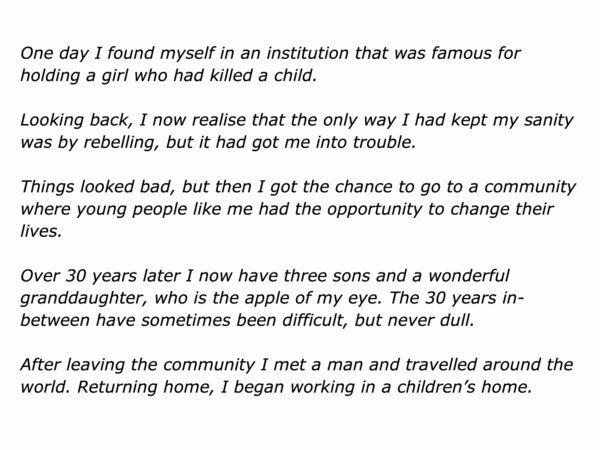
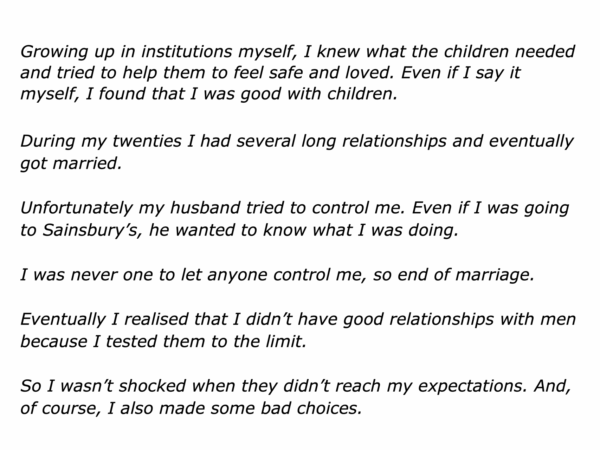
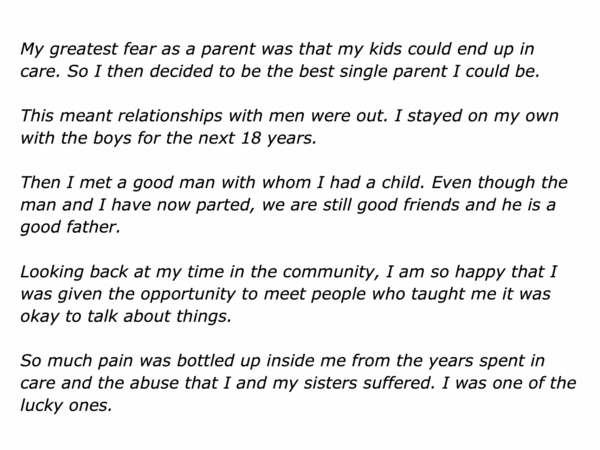
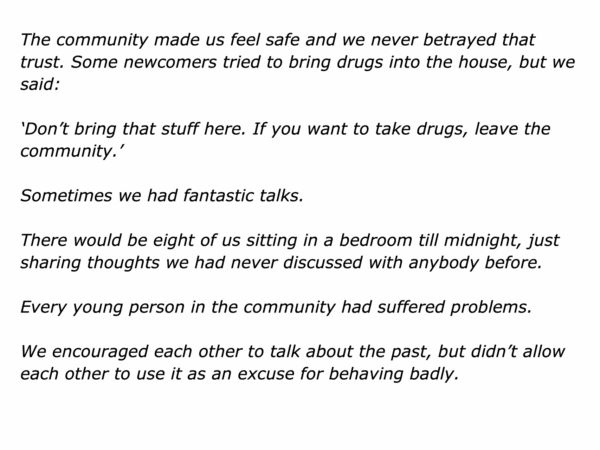
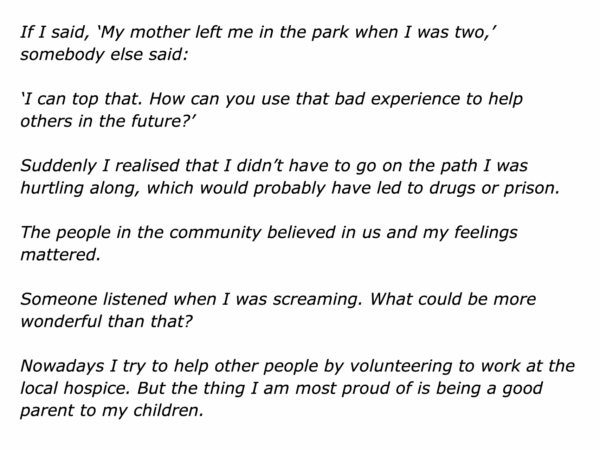
Sue is somebody who chose to shape her life in a positive way. In 1970 she came to the therapeutic community I was running for young people. Abandoned by her mother at the age of 2, she had suffered abuse in institutions. The community gave young people the chance to shape their futures.
Sue recognised she was at a crossroads and began pursuing her chosen route. Many years later, in 2005, she emailed me to describe her journey over the past three decades.
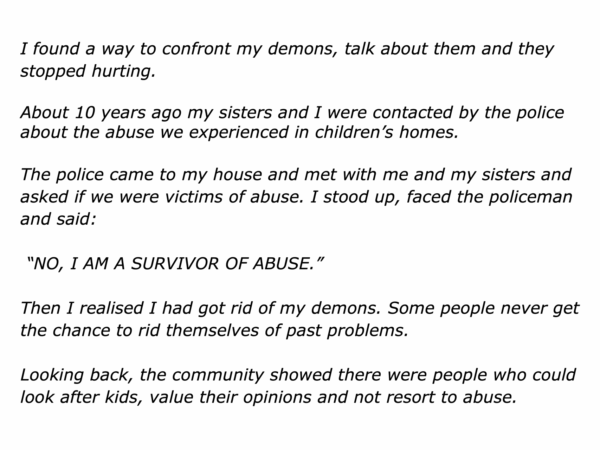
Visited later by the Essex police investigating events at the children’s homes, the police asked if she was a victim of abuse. Sue declared:
“No, I am a survivor of abuse.”
Here is the piece she wrote about her journey.

Different people choose different ways to do their personal best. The following pages describe exercises that people can use to follow this approach.
The ‘You Have An A Grade’ Approach
This section looks at two ways of agreeing with people on the grade that they want to achieve at the end of the year. It starts with one drawn from the arts and continues with an approach I saw work in one company.
Benjamin Zander, a conductor with the Boston Philharmonic Orchestra, describes his approach to encouraging young performers do their best.
He tutors students who travel from around the world to pursue their musical studies in America. They are often financially supported by families who have saved to provide the necessary funding.
The students feel nervous on their first day in college. Anxious not to disappoint their parents, they are worried about passing their final exams. Benjamin greets the assembled students by saying something like the following.
You Have An A Grade
Let me put your minds at rest. You already have an A grade. But this is dependent on several things.
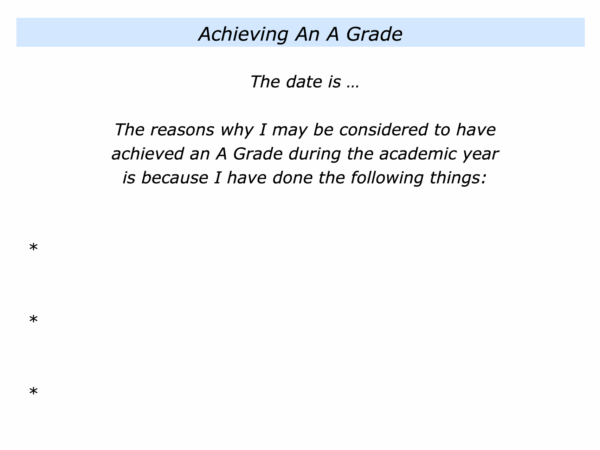
First, write me a letter dated May next year – the end of your time in college – titled Achieving An A Grade.
Imagine you are writing the letter after completing the course. Start with the words:
‘The reasons why I may deserve be considered to have achieved an A Grade during the academic year is because I have done the following things …’
Second, you and I will meet to discuss your proposed achievements and whether these deserve an A. If not, we will agree on what you want to you need to do to achieve another grade.
Third, it is then up to you to do the things required to reach the agreed grade.
Let’s move on to another area where people are encouraged to do their personal best. This is the challenging topic of performance appraisals in organisations. Let’s have a look at one unconventional approach.
Performance Appraisal – The Agreeing On
The Rating At The Start Of The Year Approach
There are many models for doing performance appraisal or performance management. The following section describes one approach that I have seen work in a company. This involved going through the following steps.
Step One – Agreeing On The Rating
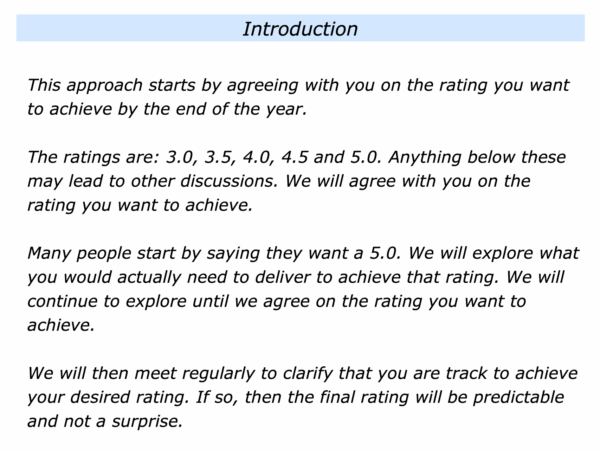
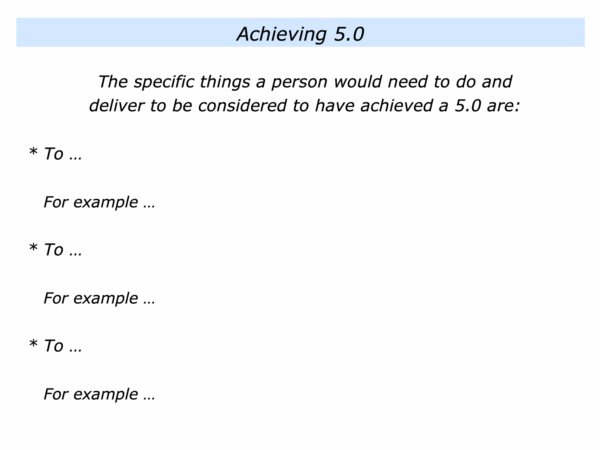
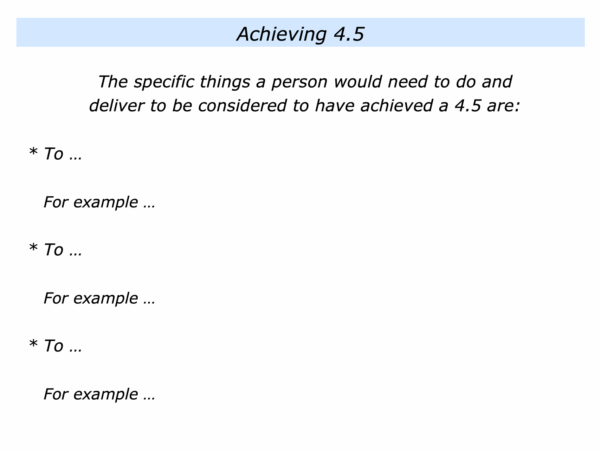
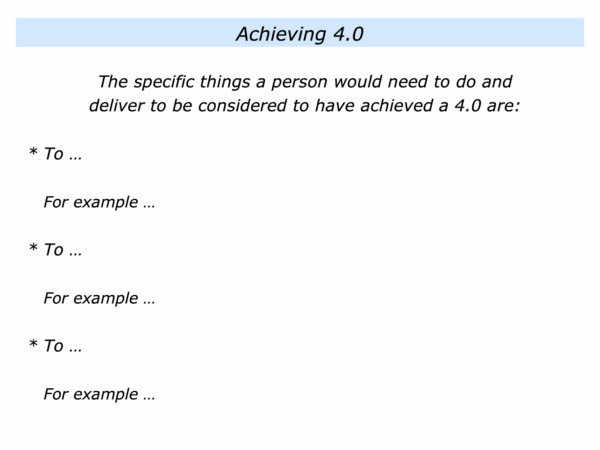
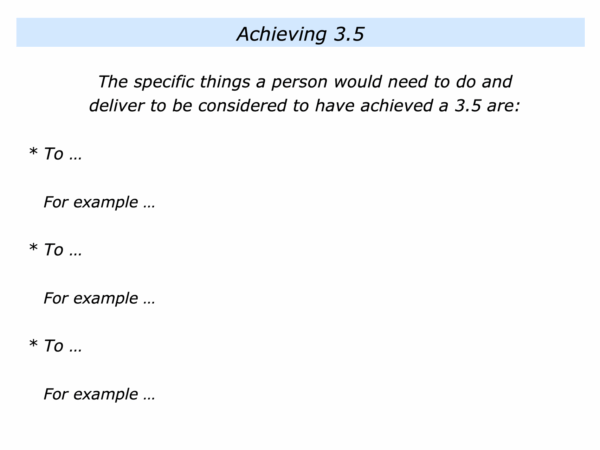
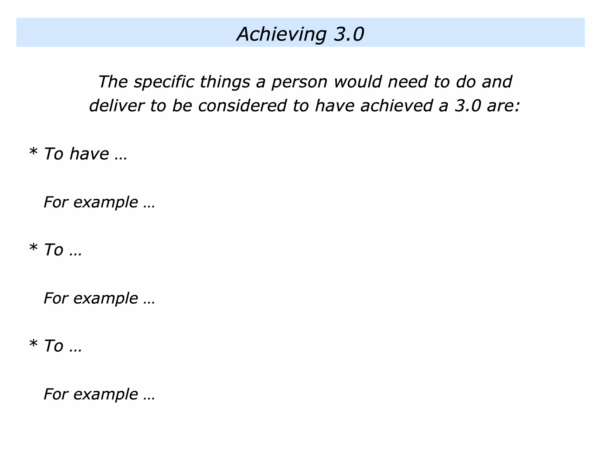
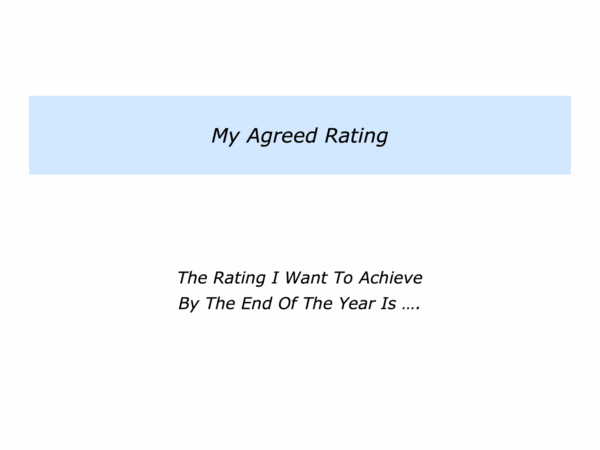
This involved meeting with the person and agreeing on the rating they want to achieve by the end of the year. The manager outlined that the available ratings were 5.0, 4.5, 4.0, 3.5 and 3.0. Anything below those could lead to other types of discussions.
The manager asked the person what rating they would like to achieve in the year. Naturally, many people said they wanted to get a 5.0. The manager then outlined what would be required to achieve such a rating.
This might mean delivering double their agreed target, producing a ground-breaking innovation, all their team achieving 100% job satisfaction and many other deliverables. The person might then say something along the following lines.
“That sounds a tall order. What do I need to do and deliver to get a 4.5?”
The conversation would continue until the person settled on an agreed rating.
The company made it clear that:
It was certainly okay for a person to aim for a 3.0, 3.5 or another grade.
There may be times in a person’s life that they may prefer to go for such a rating. The company also made it clear that 3.0 was the lowest acceptable grade – but that included being professional and reaching certain targets.
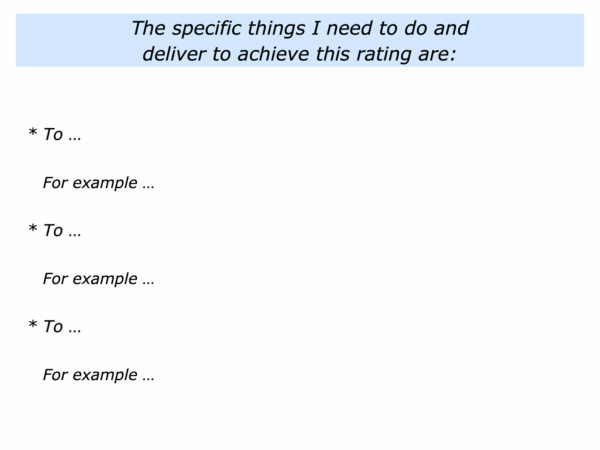
The person settling on the rating they wanted to achieve. They then translated this into describing the things they needed to do and deliver to achieve that rating.
Step Two – Meeting Regularly To
Clarify If On Course To Deliver The Rating
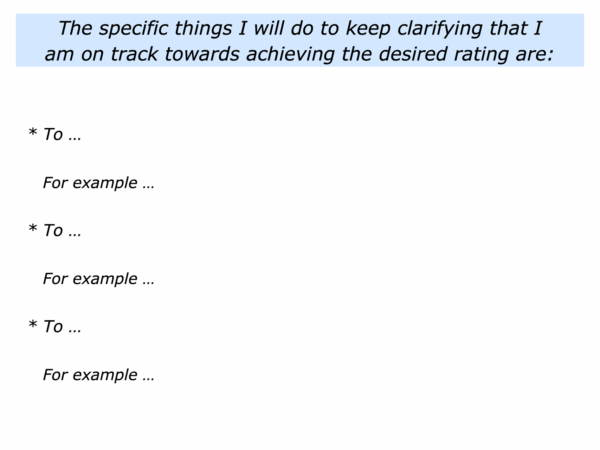
The person had regular meetings with their manager to clarify that they were still on course to deliver the agreed rating.
This provided a good reality check and also showed the progress being made towards delivering the agreed outcomes. Sometimes outside events occurred that meant it was appropriate to review the goals or review the agreed rating.
Step Three – Meeting At The End Of
The Year To Confirm The Agreed Rating
This session was held at the end of the year and the session was normally predictable.
The person and the manager had made clear contracts at the beginning of the year and agreed on the desired rating. They had then met regularly to keep doing reality checks.
The company found that people normally delivered what had been agreed and achieved their desired rating. This made the sessions predictable with few surprises.
Sometimes there were deviations, but these were managed in a professional way. The company used this approach to make the performance appraisal sessions beneficial to both the individual and the company. Here are some of the tools they used to facilitate such sessions.
There are many ways to do fine work. One approach is to play to your strengths, follow your principles and do your personal best.
When doing so, however, it can be important: a) to be the best you can be rather than comparing yourself to others; b) to do your best but also dare to be imperfect. Let’s explore this second approach.
The Daring To Be
Imperfect Approach
Olivia Hurley, an assistant professor and sports psychologist, described elements of this approach in her article What We Can Learn About Resilience From Elite Athletes. Here is an excerpt from the article.
Have The Courage To Be Imperfect
Too often in life, we aim for ‘perfection’. As sport psychologists we should not recommend athletes use this term.
Instead we should work together to help them to produce Personal Bests (PBs), helping them to aim for performance excellence, but not expecting perfection.
Such PB targets should not stop anyone from giving one hundred per cent effort to their performances. But, by not feeling the need to be perfect, they are more likely to ‘have a go’, which often leads to the most effective performances.
Jeremy Snape, a sports psychologist, described how it is important to be fully committed rather than worrying about being perfect. He explained this in the following way.
“Perfectionism can be good for driving your work ethic and your attention to detail. But it can also cause stress, procrastination and even avoidance – because you’re afraid of not achieving it.
“The really great sportspeople have the courage to throw themselves into any endeavour with 100% commitment, knowing that it’s going to be imperfect.”
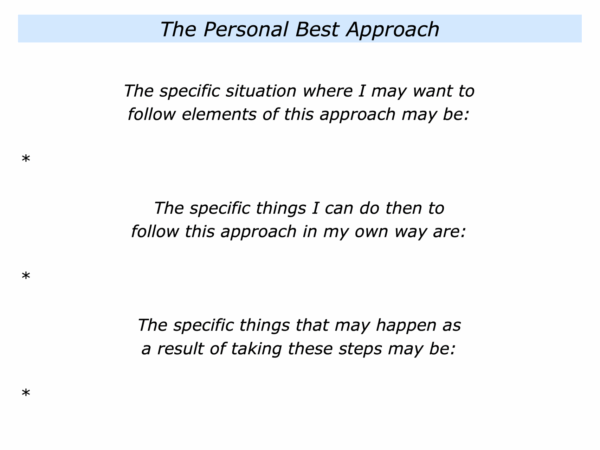
Let’s return to your own life and work. Looking ahead, can you think of an activity where you may want to build on your personal strengths, follow your principles and do your personal best? How can you follow this approach in your own way?
If you wish, try tackling the exercise on this theme. This invites you to complete the following sentences.

Leave a Reply