



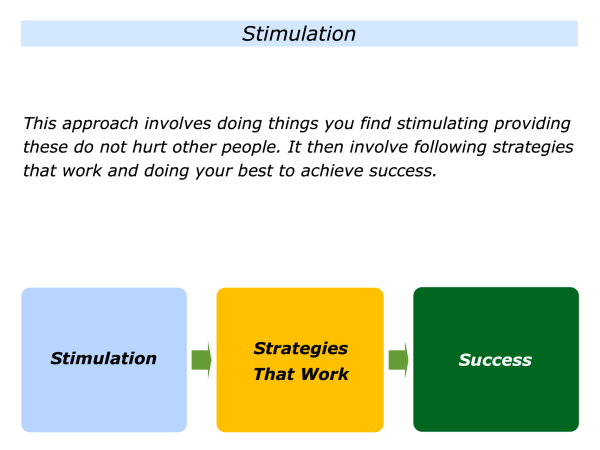
There are many ways to live and work. One approach is to follow the stimulation, strategies that work and success approach. This involves focusing on the following themes.
Stimulation – This involves doing things that you find stimulating providing they do not hurt other people.
Strategies That Work – This involves setting specific goals, studying what works and following strategies that work.
Success – This involves doing superb work, finding solutions to challenges and doing your best to achieve the picture of success.
This is an approach that is sometimes followed by people who want to maintain their zest for life, be creative or find a new purpose. It is one that is used by people from all walks of life.
Imagine that you want to follow elements of this approach in your own way. This involves focusing on the following things.
Stimulation
The first step is to do things you find stimulating providing these don’t hurt other people. Different people will do different things. Here are some that people mention when exploring this theme.
Stimulation – The specific things
that I find stimulating are:
To do things that give me positive energy … To focus on what I can control … To be grateful and count my blessings … To encourage people … To be generous … To write positive articles.
To go for a walk … To read inspiring stories … To listen to certain music … To be with my dogs … To sleep … To potter around … To do things that make my heart sing … To find solutions to specific challenges.
To paint … To cook food … To study success … To be with positive people … To listen to the sound of water … To play to my strengths … To work with certain clients … To pass on knowledge to people.
Different people follow this approach for different reasons. Some people simply want to revitalise themselves. Some peak performers follow this approach after being in a state of flow.
Such individuals have often felt high when competing in an event, playing on stage or performing at their best. Coming out of this state can lead to feeling of frustration or restlessness.
Sometimes it can be appropriate for them to embark on the next challenge. Sometimes it can be useful for them to rest, reflect and revitalise themselves by doing something they find stimulating.
Some people get inspiration from their equivalent of a wellspring or a muse. This could be a book, a piece of music or a stimulating sanctuary. Here is a dictionary explanation of the role played by Muses.
The Muses were nine goddesses who were believed to give encouragement in different areas of literature, art and music. A person about to begin work would call on their particular Muse to inspire them.
A muse may also be one’s special creative spirit. It can also be an imaginary force that gives ideas and helps you to write, paint or make music. It can also be a physical representation of this force.
Some people may also find that serendipity plays a part in getting stimulation. They may hear a chance remark or experience something that sparks their imagination. They may then translate into action by doing a specific project.
You will have your own approach to getting stimulation. As mentioned earlier, you may do things that give you positive energy.
Sometimes you may simply relax and let your mind wander. You may rest, sleep or potter around. Sometimes you will aim to flow rather than force anything. Then sometimes ideas appear that provide the wellspring for inspiration.
If you wish, try tackling the exercise on this theme. This invites you to describe the things that you sometimes find stimulating. We will then explore how you may want to pursue some of these activities.
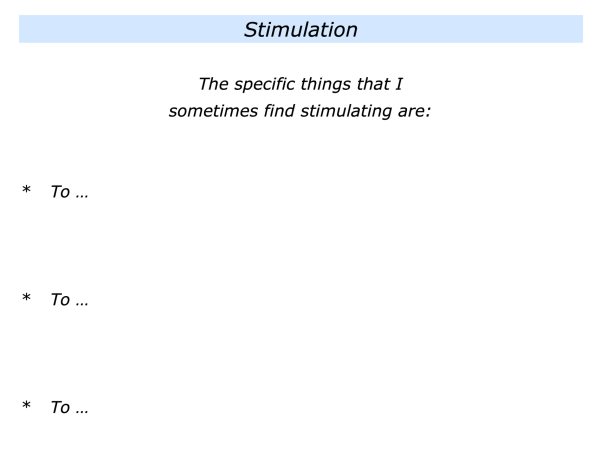
Let’s assume that you have described some of the things you find stimulating. If appropriate, you may then wish to move on to the next stage.
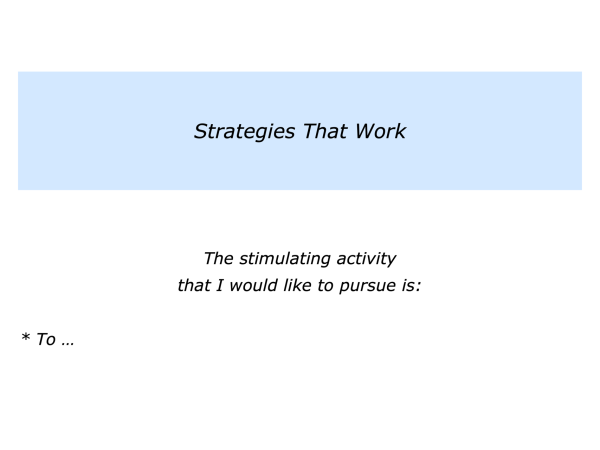
Strategies That Work
The next step may be to focus on a stimulating activity you want to pursue. It can then be to set specific goals, study what works and follow strategies that work. Let’s explore these themes.
You Can Set Specific Goals
Looking ahead, you may want to focus on encouraging a person, running a workshop, caring for a garden or doing another activity. You may want to do a piece of work, tackle a challenge or achieve a specific goal.
There are many ways to set specific goals. Bearing in mind what you can control in a situation, one approach is to focus on the stimulating activity you want to pursue. It then to explore the following themes.
What are the specific goals – the real results – I want to achieve when pursuing this activity? What is the picture of success? What will be the benefits of achieving this picture of success?
Imagine that you have begun to clarify your specific goals. You will, of course, do this in your own way. At some point, however, it may be appropriate to follow elements of this framework.
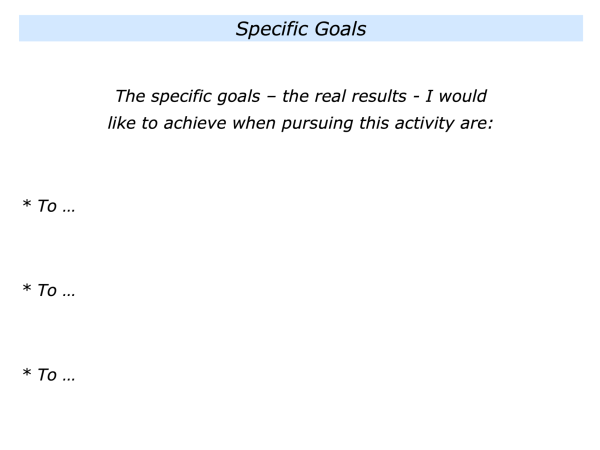
Specific Goals
The specific activity I want to pursue is:
*
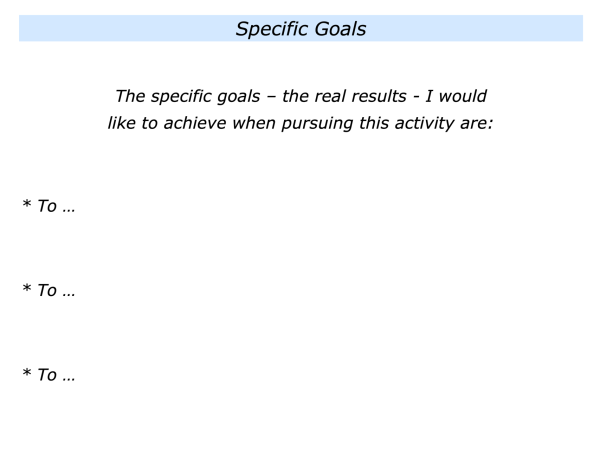
The specific goals – the real results – I want
to achieve when pursuing this activity are:
*
*
*
The specific benefits of
achieving these goals will be:
*
*
*
Let’s assume you have started to settle on your goals. The next step will be to clarify the strategies you want to follow. Before doing that, however, it can be useful to explore the following theme.
You Can Study What Works
How to clarify the strategies most likely to work? One approach is to study success. Bearing in mind the results to achieve, you can explore the following themes.
You can learn from your own positive history
Looking back, can you recall a time when you tackled a similar challenge successfully? What did you do right then? What were the principles you followed? How can you follow similar principles – plus maybe add other skills – to reach your goals successfully?
You can learn from other people’s positive history
Looking around the world, are there any people who may have done similar work successfully? What did they do right then? What were the principles they followed? How can you follow similar principles in your own way to reach your goals successfully?
Let’s assume that you have explored these questions. When appropriate, you may then move on to the next theme.
You Can Follow
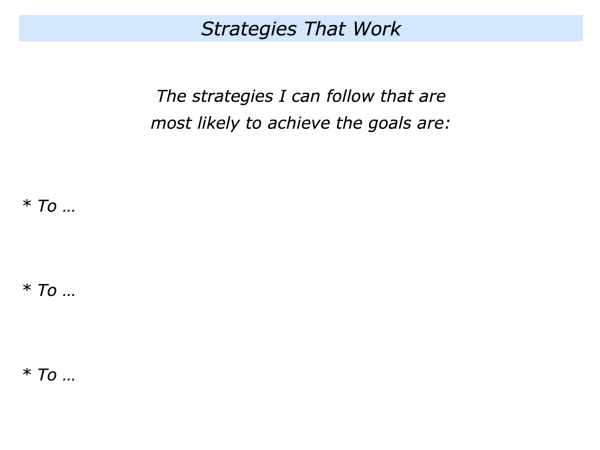
Strategies That Work
Imagine that you have clarified the goals you want to achieve. You can then clarify the strategies that are most likely to work. Bearing in mind what you can control in the situation, you can explore the usual strategic questions.
What are the real results I want to achieve? What are the key strategies I can follow to give myself the greatest chance of success? How can I translate these into a clear action plan?
What are the possible challenges I will face along the way? How can I prevent some of these happening? How can I manage any of these if, despite my best efforts, some do happen?
Bearing in mind the results I want to achieve, how can I get some quick successes? How can I encourage myself on the journey? What else can I do to increase the chances of achieving the goals?
Imagine that you have explored these themes. If appropriate, you may then want to rehearse translating these into action. There are many models for mental rehearsal. One approach is to take the following steps.
You can rehearse translating the strategies into action on the way towards achieving the picture of success.
You can rehearse managing any challenges you may face on the way towards achieving the picture of success.
You can again rehearse following your chosen strategies on the way towards achieving the picture of success.
If appropriate, you can then summarise how to follow the strategies by doing the following exercises.
Success
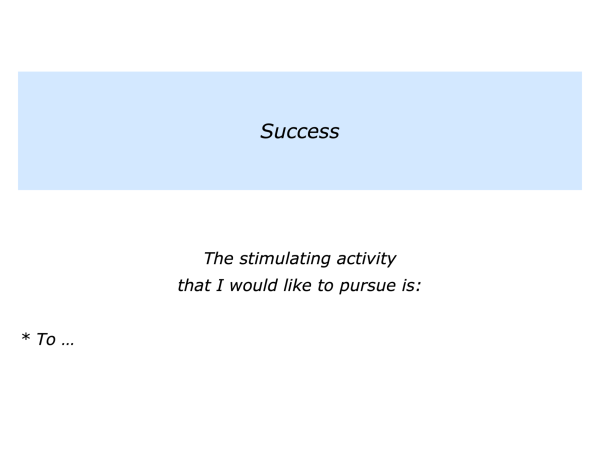
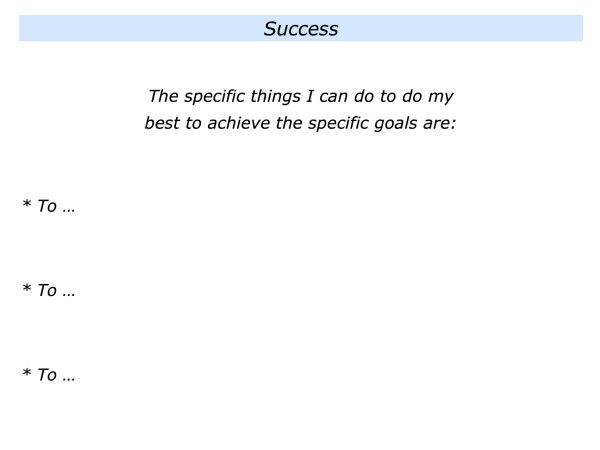
Imagine that you are pursuing a stimulating activity and are following strategies that work. The next step is to do your best to achieve the desired results – the picture of success.
Different people do their best in different ways. Some set aside blocks of times to do deep work on their chosen project. They then follow their successful style of working.
Some people follow a certain rhythm. They manage their energy to make use of their prime times – the times of the day when they have most energy – and make full use of these times.
Such people set reachable goals for the session and go through the stages of absorption, adventure and achievement. They aim to get successes on the way towards achieving their long-term goals.
Such people manage their energy properly. They follow a certain rhythm but also build in time for rest, recovery and rejuvenation. Rehearsing what they are going to do next, they then throw themselves back into doing the work.
Some people enjoy finding solutions to challenges along the way. Bearing in mind their successful pattern for finishing, they then aim to flow, focus and finish successfully. Some also add that touch of class.
There are many ways to live and work. One approach is to do the things you find stimulating, follow strategies that work and do your best to achieve success.
If you wish, try tackling the final exercise on this theme. This invites you to complete the following sentences.

Leave a Reply