



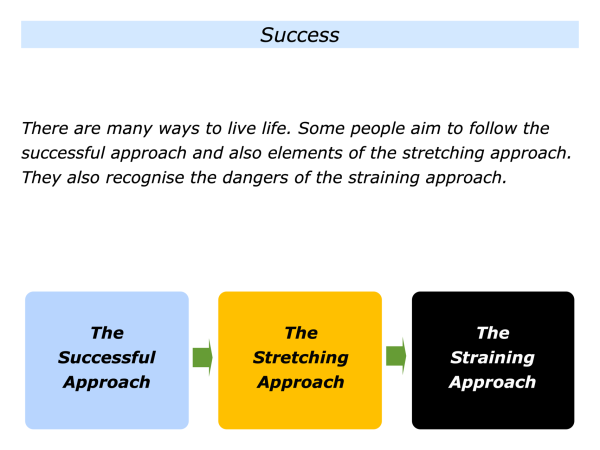
There are many ways to live and work. Some people follow the successful approach. They aim follow successful principles that work for individuals, teams or organisations.
Some people may also follow elements of the stretching approach. They may aim to stretch themselves physically, philosophically or psychologically to go into new dimensions and achieve success.
Some people may also go into the straining approach. Sometimes this can work for an individual, team or organisation. When followed over a long period, however, it can lead to danger and the breakdown of the system.
Different people follow these approaches in different situations. Let’s explore how they may translate these into action.
The Successful Approach
People who follow this approach often study success. Bearing in mind the results they want to achieve, they study the principles that people follow to achieve success in a specific activity. They may then aim:
To build on their strengths and follow these principles in own way to achieve their picture success.
Such people aim to study what works, simplify what works – in a profound way – and then do what works. They study humanity at is best and then follow these principles in their own way.
They may do this when aiming to encourage other people, create an inspiring school, lead a pioneering team or do another activity. Bearing in mind the activity they want to pursue, they explore the following themes.
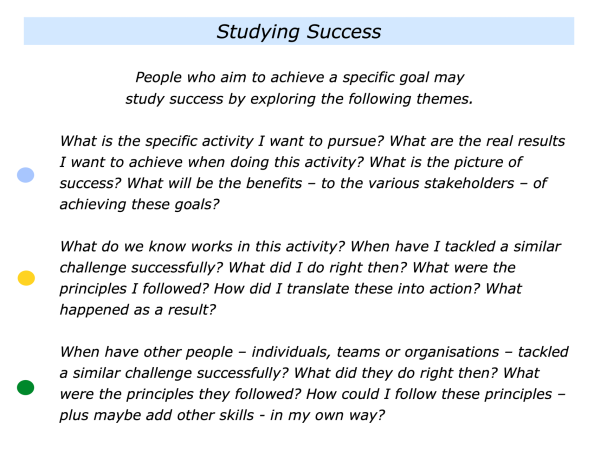
Imagine that a person has explored what works in a specific activity. Bearing in mind the results they want to achieve, they may then focus on the following themes.
What are the key strategies I can follow that are most likely to achieve success? How can I anticipate and manage any potential challenges? What else can I do to increase the chances of achieving success?
Such a person will rehearse following their strategies and dealing with any challenges. They will then move into action and aim:
To focus on the picture of success … To follow the strategies most likely to achieve the picture of success … To do their best to achieve the picture of success.
Let’s return to your own life. Looking back, can you think of a situation when you may have followed some elements of this approach? If you wish, try tackling the exercise on this theme.
The Stretching Approach
Some people may sometimes stretch themselves to go into another dimension. They may stretch their body, brain or other senses to go into their equivalent of the zone.
Some may stretch themselves physically. Many athletes follow this approach to make sure their bodies are supple and more elastic. They are then more able to perform at their best.
Some may stretch themselves philosophically. They may do this by being creative, exploring new ideas and expanding their thinking. This can help to expand their repertoire for finding solutions to challenges.
Some may stretch themselves psychologically to build their emotional and mental strength. They may aim to develop their resilience to manage crises and other challenging scenarios.
Some organisations take a similar approach after settling on the strategies they want to pursue. They stress test these strategies in various scenarios.
Such organisations see this as a vital step before going live. They need to know the strengths and limits. They can then put in place strategies that are most likely to help them to achieve their goals.
Looking at your own life, can you think of ways that you may enjoy stretching yourself? You may do this by stretching your body, imagination, creativity or by doing other activities.
If you wish, try tackling the exercise on this theme. This invites you to complete the following sentences.
The Straining Approach
Some people may sometimes move into the territory of straining themselves. This approach may work for a while, but it can lead to pain and damage.
A person can sometimes recognise the potential danger signs in their body or soul. This can happen when, for example:
They feel negative exhaustion rather than positive exhaustion;
They feels strains or tensions in their body;
They feel unhappy, detached or ill at ease.
Different people experience these symptoms in different situations. A person may be failing to manage their energy properly, performing pointless work or putting themselves in toxic environments.
Some companies may also have a policy that creates collateral damage. They go beyond asking people to deliver stretch goals and ask them to deliver surgery goals that can debilitate people. Their philosophy seems to be:
“People are straining every muscle to jump 2 metres but let’s move the bar up to 4 metres.
“We will then get lots of people to jump 2.5 metres.”
The employees may balk at first but some get on with trying to reach the new targets. They put in more hours, sleep less and strive to achieve the aims.
Some companies find that this approach may work for a while but there are downsides. They may find that people fall, resent being micromanaged or move on to find more satisfying work.
Let’s return to your own life and work. Are there any situations when you may experience elements of the straining approach? What may be the symptoms you experience?
Certainly there may be times when you simply feel tired, but there may also be times when you recognise danger signs. What may be these signs? How can you learn from or manage these feelings?
The Successful
Approach In The Future
There are many ways to live and work. Some people follow the successful approach. They aim follow successful principles that work for individuals, teams or organisations.
Some people may also follow elements of the stretching approach. They may stretch themselves physically, philosophically or psychologically to achieve success.
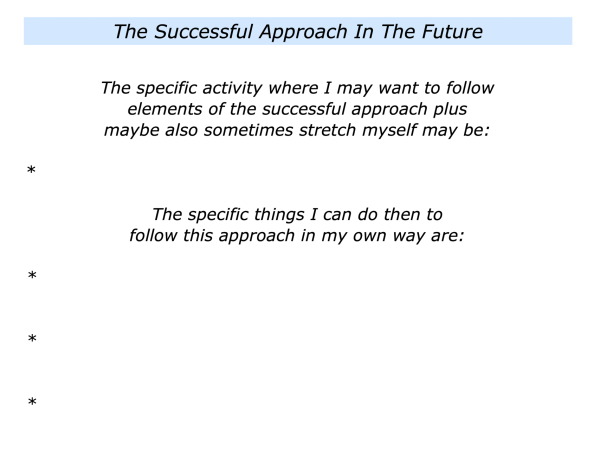
Let’s return to your own life. Imagine that you want to follow elements of the successful approach in the future. If appropriate, you may also want to stretch yourself to keep developing.
Looking ahead, can you think of a specific activity where you may want to follow these steps in your own way? What may be the benefits of taking such an approach?
If you wish, try tackling the exercise on this theme. This invites you to complete the following sentences.

Leave a Reply