



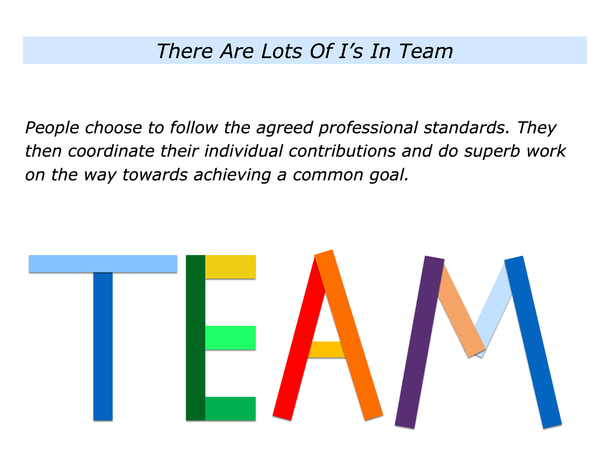
There is a cliché that there is no I in the word team. Another view is that there are many I’s involved when people combine their talents in a successful team. This can be seen on several levels.
First, this happens when people choose to coordinate their individual contributions to achieve a common goal. Sometimes they work as individuals, sometime they combine with others in the team.
Second, each of the letters in the word team is made of vertical, horizontal or diagonal I’s. If you put all of these together, then they spell the word TEAM.
The usual idea of there being no I in the word stem refers to individuals just focusing on their own agenda and this can be harmful. But many teams are made up of individuals who combine their talents to do great work.
Great teams are often made up of people who have similarity of spirit and diversity of strengths. Diversity of spirit is a recipe for disaster.
The similarity of spirit – such as delivering consistently high professional standards – is vital. It is the diversity of strengths, however, that can sometimes make the difference and deliver the goods when it matters.
Imagine that you lead a team and want to follow elements of this approach. This can involve focusing on the following themes.
You can clarify and
communicate the team’s goals
You will, of course, do this in your own way. Whatever route you take, it will be important to make clear contracts with your key stakeholders – such as the people you report to – about the following things:
The specific goals to achieve and the benefits – to all the various stakeholders – of achieving this picture of success;
The specific strategies to follow when working towards achieving the picture of success;
The specific support available that can help to increase the chances of achieving the picture of success.
Imagine that you have taken these steps. You may then communicate the team’s goals to your people. When doing so, it can be important to explain the context and give people the big picture.
Different leaders will do this in different ways. One approach is for them to adapt elements of the following framework.
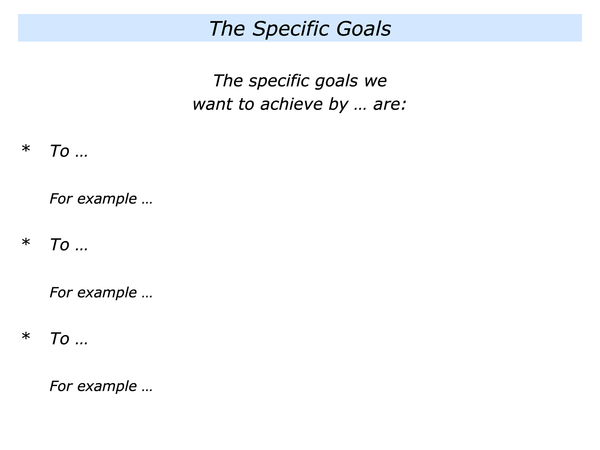
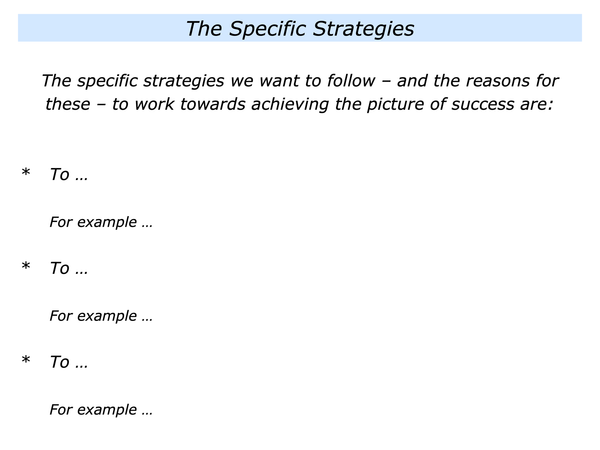
Different leaders communicate the goals in different ways. Some also invite people to add their ideas. Whilst the goals are not up for debate, they invite people to give their responses to the picture of success under the following headings.
The Picture Of Success
* The things they like about it.
* The additions and suggestions they have.
* The concerns and questions they may have.
* The Success Rating.
This is a vital part. People are to write the rating they would give – on a scale 0-10 – regarding the team being able to achieve the goals. They are also to give their suggestions for improving the rating
Leaders who take this approach aim to incorporate some ideas that people suggest. The key part is The Success Rating. It is important to implement any ideas that will improve the chances of achieving success.
Let’s assume that you have followed elements of this approach. You can then move on to the next stage.
You can make clear contracts
about people’s individual
contributions to achieving the goals
Imagine that you have communicated the team’s picture of success. If appropriate, you can then move on to the next part. You can aim:
To give the individuals time to reflect to decide if they want to contribute towards achieving the goals and, if so, then;
To, bearing in mind each individual’s strengths, clarify their best contributions to achieving the goals;
To make clear contracts with them about: a) the specific results they will deliver; b) the support they need; c) the specific things they will do to keep you informed about their progress towards achieving the goals.
Some people will be making individual contributions. Some may be cooperating with others to deliver certain results. The key, however, is to make clear contracts about the specific things they will deliver.
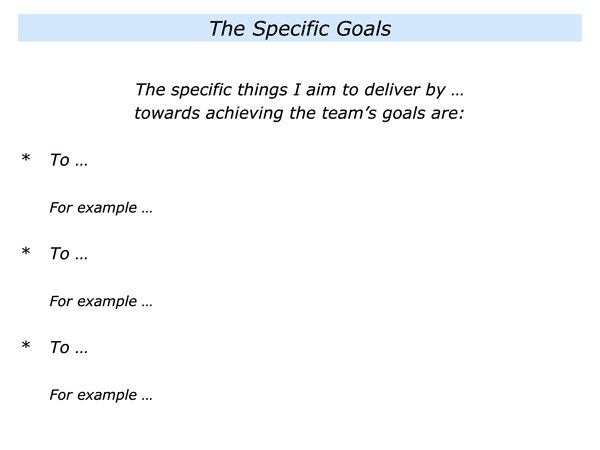
One approach is to invite them to complete the following framework. This can then become a working document where you both focus on the outcomes they will aim to deliver towards achieving the team’s goals.
You can coordinate people’s individual
contributions and work to achieve the goals
Imagine that you have made clear contracts with the individuals about their contributions. The next step will be to coordinate people’s efforts on the way towards achieving the team’s goals.
Some leaders take the main role in this approach. Some work alongside a good coordinator. Such a person then helps to orchestrate people’s strengths to achieve the picture of success.
Whatever approach is taken, however, it is vital to manage by outcomes rather than by tasks. This involves aiming:
To keep reminding people about the goals and the benefits of achieving the picture of success;
To highlight when people have done superb work, the strategies they followed and how to build on these to achieve the picture of success;
To focus on the specific issues that are in the Green, Amber and Red Zones plus how to build on or improve these things to achieve the picture of success.
There are many ways to build teams. One approach is for people to agree to follow certain professional standards. It is then to coordinate the many I’s – the individual’s contributions – to deliver the picture of success.
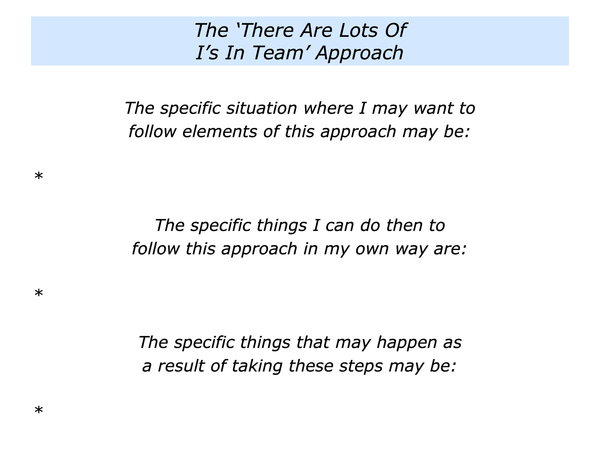
Looking ahead, can you think of a situation where you may want to follow elements of this approach? If you wish, try tackling the exercise on this theme. This invites you to complete the following sentences.

Leave a Reply